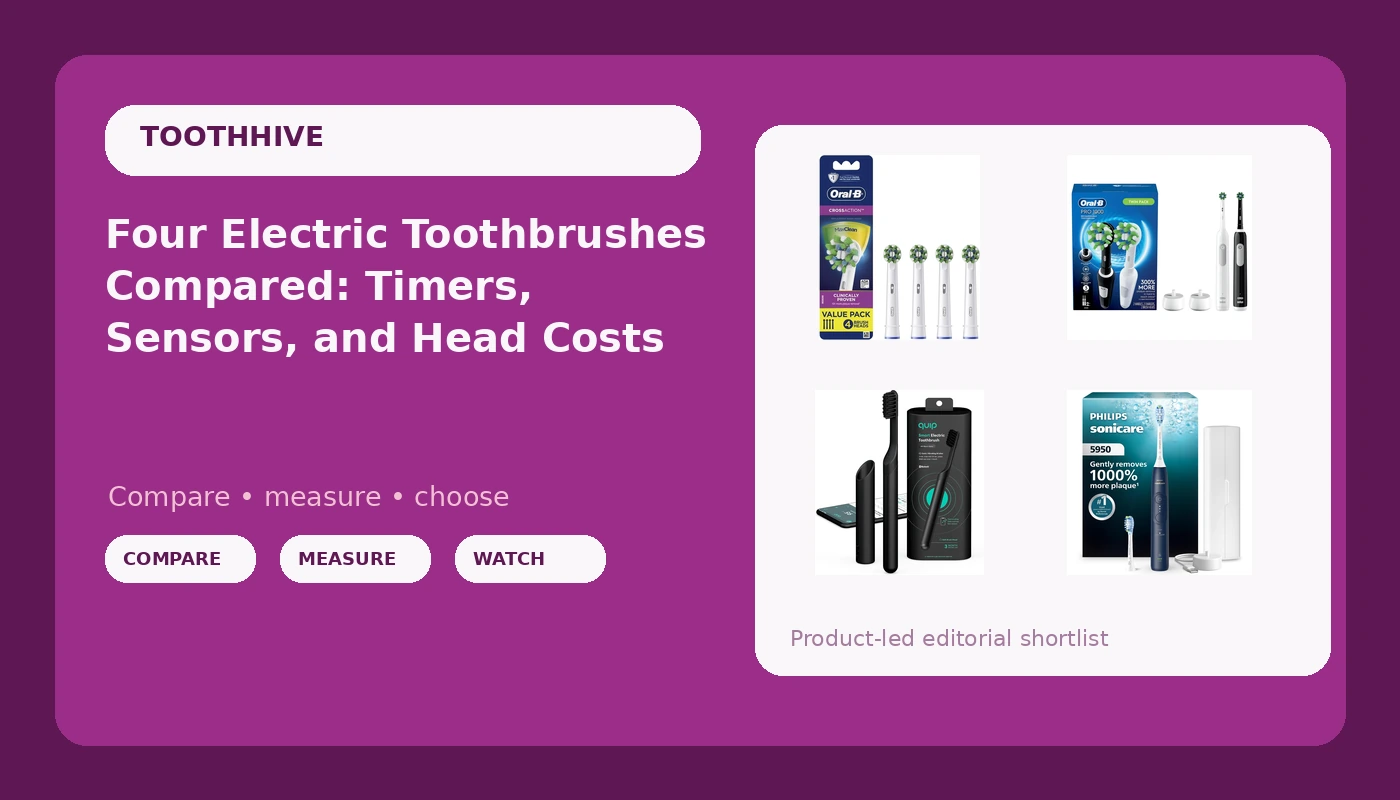
The electric toothbrush aisle is built to make you spend more than you need to. Handles with color screens, apps that score your brushing, price tags that climb past the cost of a professional cleaning. None of that answers the two questions that decide whether your gums are healthier in six months: will you actually hold this thing against your teeth for two minutes, twice a day, and will you still be willing to pay for replacement heads in month eight?
This electric toothbrush comparison covers four specific products that span the realistic range: a rechargeable sonic handle, an entry-level Oral-B two-pack, a timer-first starter brush, and the refill heads that set your yearly cost no matter which handle you choose. The point is not to crown a winner. The point is to match a handle to the habits you already have, because the brush that sits in a drawer cleans nothing.
Related: Oscillating vs Sonic Toothbrushes: Does the Motor Type Matter? →
Quick answer
Pick the handle whose timer, head cost, and grip fit your routine, because every product here can remove plaque when it is used properly for the full two minutes. If you want one rechargeable handle and a spare head in the box, the Philips Sonicare 5950 is the most complete single purchase of the group. If two people share a bathroom and both already like the round Oral-B head, the Oral-B Pro 1000 two-pack covers two sinks in one order. If you want the simplest possible routine and a timer that keeps you honest, the Quip is the low-effort starter. Whichever handle you land on, the Oral-B CrossAction refill pack is the reminder that heads, not handles, are the real subscription.
4 useful options
| Model | Best fit | What stands out |
|---|---|---|
| Philips Sonicare 5950 Rechargeable Electric Toothbrush, 2 Brush Heads, Navy | One rechargeable handle for a single brusher | Rechargeable sonic handle with two brush heads included |
| Oral-B Pro 1000 CrossAction Electric Toothbrush, Black and White, 2 Count | Two people, two sinks, one order | Two complete brushes in one pack, both taking CrossAction heads |
| Quip Smart Sonic Toothbrush for Adults - Timed Electric Toothbrush with Bluetooth & Rewards App - Replaceable Brush Head, Soft Bristles, Metal Handle, 3 Month Battery Life - Travel Brush - All-Black | A simple, timer-driven routine | Built-in timer, soft bristles, metal handle, Bluetooth rewards app |
| Oral-B CrossAction Electric Toothbrush Replacement Brush Heads Refill, 4ct | Any Oral-B handle owner | Four replacement heads in one pack, the recurring cost of ownership |
The rechargeable all-rounder: Philips Sonicare 5950
The reason this one leads the group is practical rather than technical: it is the only single-handle option here that ships with a second head. That matters because the first thing most new electric brush owners do is run the original head past its useful life while they shop around for refills. Having a spare in the box buys you a few weeks of breathing room and keeps the routine going. The trade-off is that you are buying one handle, not two, so it suits a single brusher or a household where the second person already has a brush they like.
The budget workhorse: Oral-B Pro 1000
The case for this one is arithmetic. Two handles for a household usually costs less than buying one premium handle twice, and the round Oral-B head is the most widely recognized brush head shape in dentistry, which makes refills easy to find. The trade-off is that you get two handles and no extra heads, so budget for a refill pack at the same time as the brushes, not three months later. If you are switching a partner or a teenager over to an electric brush, this is the least expensive way to put a real two-minute timer at both sinks.
The simple starter: Quip Smart Sonic Toothbrush
Be clear about what this is and what it is not. Quip is a manual-shaped brush with a motor and a timer, not a high-amplitude sonic cleaner, and that is exactly why some people stick with it. It is slim, it travels well, the all-black finish does not look like a medical device on the counter, and the three-month battery figure in the listing means fewer charging cables in your bag. The trade-off is cleaning power and, over time, head cost through the subscription model. If your problem has never been technique and has always been consistency, a gentle brush you actually enjoy holding is worth more than a powerful one you avoid.
The consumable: Oral-B CrossAction refill heads
Here is the part of the decision almost nobody thinks about at checkout. A toothbrush handle is a one-time purchase; heads are a recurring one, and they are where the money actually goes. A four-pack covers a single brusher for roughly a year at the standard three-months-per-head guidance, which is why the cost per head matters more than the cost of the handle. Work out the yearly head cost for any brush you are considering before you fall in love with the handle, and buy refills in multi-packs rather than one at a time.
Prices and availability change, and listings can be updated by the seller at any time. Confirm the current details, included accessories, and head compatibility on the retailer page before you buy.
What actually removes plaque
Plaque is a soft, sticky film of bacteria that forms on teeth within hours of brushing. It is not bonded to the enamel the way tartar is, which means it comes off with mechanical disruption: bristles physically sweeping across the tooth surface and, critically, along the gumline where the film collects first.
That single fact explains why technique beats technology. A brush with a brilliant motor held against the front teeth for twenty seconds removes less plaque than a modest brush moved systematically around all four quadrants for the full two minutes. The variables that predict a clean mouth are coverage, time, and pressure, roughly in that order.
Coverage means reaching the surfaces people skip: the outside of the back molars, the inside of the lower front teeth, and the sulcus, the shallow groove where the tooth meets the gum. Time means two full minutes, because that is what it takes to cover every surface at a reasonable pace. Pressure means light, because scrubbing harder does not remove more plaque, it just traumatizes the gum tissue and, over years, contributes to recession.
This is also why "plaque score" is the honest measure when comparing brushes. A feel test after brushing tells you the toothpaste tasted good. A plaque-disclosing tablet or a hygienist's score after a proper brushing session tells you what was actually removed. Any comparison that skips that step is marketing.
Oscillating versus sonic, and the features worth paying for
There are two main motor designs on the market. Oscillating-rotating brushes, which is the Oral-B family, use a small round head that spins back and forth and pulses. Sonic brushes, which includes Philips Sonicare and Quip, use a longer head that vibrates side to side at high frequency, with the vibration doing part of the work of breaking up the film.
Both designs have clinical support, and neither one rescues poor technique. The round head has a mechanical advantage around a single tooth at a time, which some people find easier to use well. The longer sonic head covers more surface per stroke, which some people find faster. Motor type is a preference question, not a health question.
What is worth paying for is narrower than the marketing suggests:
- A two-minute timer with 30-second quadrant prompts. This is the single most useful feature on any electric brush, because it converts an intention into a routine. If a brush cannot pace you through four quadrants, it is not doing the one job that matters.
- A pressure sensor. Brushing too hard is the mechanism behind a lot of gum recession, and a sensor that warns you is the closest thing to a technique coach built into the handle.
- Affordable replacement heads. A brush whose heads cost more than the handle every year is a subscription with a motor attached.
- A handle you will actually grip. If it is heavy, slippery, or awkward, it will end up in the drawer.
Everything above that line, including color screens, brushing scores, and app dashboards, is optional. Apps can help some people stay consistent, and there is nothing wrong with that, but they should not be the reason you spend three times more on a handle.
A sensible order of operations:
- Decide how many brushes you actually need, one or two, before you look at features.
- Confirm the brush has a two-minute timer with 30-second quadrant intervals.
- Check whether it has a pressure sensor, especially if your gums have ever receded.
- Calculate the cost of replacement heads for one year, not the price of the handle.
- Buy the refills with the brush so you never run a frayed head for an extra month.
Habits that matter more than the handle
- Hold the brush at a 45-degree angle toward the gumline, not flat against the crowns of the teeth.
- Let the brush do the work. If your hand is doing the scrubbing motion, you are brushing manually with extra steps.
- Spend 30 seconds per quadrant and let the timer move you along instead of guessing.
- Replace the head when the bristles splay, which is roughly every three months, and sooner if you have been pressing hard.
- Do not rinse immediately with a mouthwash that contains alcohol if you want the fluoride from your toothpaste to keep working; spit, do not rinse, is the standard advice.
Which option should you choose?
Choose the Philips Sonicare 5950 Rechargeable Electric Toothbrush, 2 Brush Heads, Navy when you want one rechargeable sonic handle and you would rather have a spare head in the box than a second handle. Choose the Oral-B Pro 1000 CrossAction Electric Toothbrush, Black and White, 2 Count when two people need brushes and the round head shape works for both of you. Choose the Quip Smart Sonic Toothbrush for Adults when consistency is your weak point and a slim, timed, travel-friendly brush is the one you will actually pick up. Add the Oral-B CrossAction Electric Toothbrush Replacement Brush Heads Refill, 4ct whenever an Oral-B handle is in the picture, because the refill is the part of the purchase you will repeat.
One caveat worth stating plainly: brush performance is not the same as brush marketing, and no handle compensates for skipping the gumline or cutting the session short. If you have gum disease, recession, or sensitivity, the choice of brush is a secondary question next to what your dentist or hygienist recommends for your specific mouth.
The bottom line
All four products here can support a healthy mouth, and the differences between them come down to how many handles you need, how simple you want the routine, and what the heads cost over a year. The Sonicare 5950 covers a single brusher with a spare head included. The Oral-B Pro 1000 two-pack puts a timer at two sinks for one purchase and uses the most widely available head style. The Quip trades cleaning amplitude for simplicity, soft bristles, and portability. And the CrossAction refill pack is the reminder that the handle is the down payment and the heads are the ongoing bill. Buy the brush you will use for two minutes, twice a day, and buy the refills before you need them.