Most people shopping for a rechargeable electric toothbrush end up choosing between two extremes: a premium handle with an app they will open twice, or a cheap drugstore brush whose motor never had a chance. The useful range sits between them, and it is narrower than the shelf at the store suggests.
Here is the part the packaging will not tell you. What separates a brush that removes plaque from one that just buzzes against your teeth is a short list: a two-minute timer with 30-second quadrant prompts, a brush head that reaches the gum line, a pressure sensor that stops you from scrubbing, and a handle you will still be using in three months. Motor type matters less than the marketing implies, and both major designs clean well when they are used correctly and for long enough.
Related: How Often Should You Replace a Brush Head? →
Quick answer
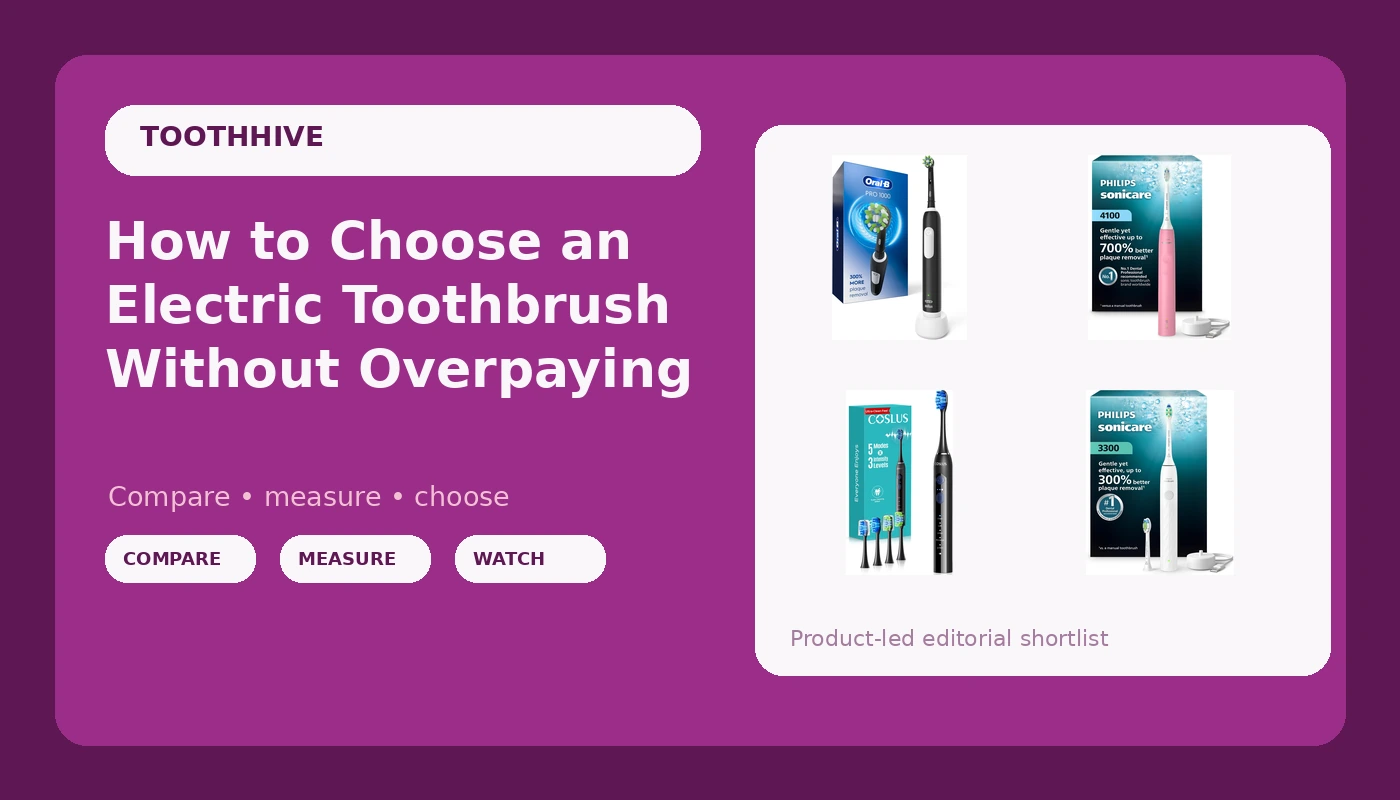
For most adults, the sensible starting point is a rechargeable handle from a major brand that has a quadrant timer and a pressure sensor, and the Oral-B Pro 1000 has filled that role for years. If you prefer a sonic brush, the Philips Sonicare 4100 pairs the same protective features with a vibrating head. The Philips Sonicare 3300 is the pick if you want a spare brush head in the box from day one, and the COSLUS C30 is the lowest-cost rechargeable handle in this group, worth considering if you confirm the timer and the long-run head cost before you buy.
Four useful options
| Model | Best fit | What stands out |
|---|---|---|
| Oral-B Pro 1000 Rechargeable Electric Toothbrush, Black | First-time electric brush buyers | Round oscillating-rotating head with a quadrant timer and a pressure sensor |
| Philips Sonicare 4100 Rechargeable Electric Toothbrush, Deep Pink | People who want a sonic brush with gum protection | Sonic vibration with a pressure sensor and quadrant pacing |
| Philips Sonicare 3300 Rechargeable Electric Toothbrush, 2 Brush Head, White | Buyers who want a spare head included | Two brush heads in the box |
| COSLUS C30 Electric Toothbrush for Adults, Ultra-Clean, 1PC, Black | Tightest budgets | Lowest-cost rechargeable handle in this group |
The default pick: Oral-B Pro 1000 Rechargeable Electric Toothbrush, Black
The trade-offs here are honest ones. You get one brushing mode and a simple two-minute routine, not a menu of settings, and there is no app, which for most people is a feature rather than a gap. The round head is smaller than a manual brush head, so it takes a few days to get used to covering each tooth deliberately rather than scrubbing in broad strokes. Heads are widely stocked and fit most Oral-B handles, which keeps the long-run cost predictable, and the charging base takes up a small amount of counter space. The reason to start here is not that it does anything clever. It does the two things that matter without charging you for the things that do not.
The sonic pick: Philips Sonicare 4100 Rechargeable Electric Toothbrush, Deep Pink
The 4100 is the sonic answer to the same question. If a round spinning head feels aggressive against your gums, a vibrating head is often easier to tolerate, and the pressure sensor gives you a warning before you lean in hard enough to do damage. A single intensity setting means less to fiddle with, and the slim handle fits a crowded medicine cabinet. The thing to check before buying is the head supply: Sonicare heads are not interchangeable with Oral-B heads, so price a year of replacements for this specific model and make sure the ones you want are easy to find.
The two-head value pick: Philips Sonicare 3300 Rechargeable Electric Toothbrush, 2 Brush Head, White
The reason the 3300 belongs on this list is simple arithmetic. Replacement heads are the real cost of powered brushing, and starting with a spare pushes your first head purchase out by roughly three months. If the 3300 and the 4100 land close to each other where you shop, the decision usually comes down to whether you would rather have the extra head or the finish and feature set of the other handle. Read the listing carefully for the timer and pressure sensor details, because entry-level handles tend to bury those specs under the styling copy.
The lowest-cost option: COSLUS C30 Electric Toothbrush for Adults, Ultra-Clean, 1PC, Black
At this end of the market the question changes. A very low-cost rechargeable handle can be a perfectly reasonable way to get a powered brush into a guest bathroom or a gym bag, and the COSLUS C30 is the cheapest route into one in this group. What you accept at this price is less certainty: verify that the timer runs the full two minutes with interval prompts, check what a replacement head costs and how easy it is to reorder, and read the charging details carefully. If those checks pass, it is a functional brush at a fraction of the cost. If they do not, a mid-range handle with a known head supply is the better long-term buy.
Prices and availability may change. Product images, names, and retailer links must be matched by verified ASIN. Do not state a current price, rating, stock status, or measured result without current evidence.
What actually removes plaque
Plaque is a soft, sticky film of bacteria that re-forms on teeth within hours of brushing. Early on it is not chemically bonded to enamel, which is exactly why bristles can lift it off. That single fact explains why technique and coverage beat almost every specification on a product page.
Comparisons of powered brushes against manual brushing consistently favor powered handles, and the advantage comes from two places: the timer makes people brush longer, and the motor adds strokes per minute a hand cannot match. Comparisons between oscillating-rotating designs, where a round head spins back and forth, and sonic designs, where the head vibrates at high frequency, tend to land close to each other on plaque removal. Neither motion is dramatically better. Head shape and how well the head reaches your back molars usually decide the difference for a given person.
Two variables show up as more important than the motor. The first is time: most people brush for well under a minute when they rely on their own sense of timing, and a two-minute timer with 30-second quadrant prompts fixes that without asking for more effort. The second is pressure: pressing harder does not remove more plaque, but it does wear enamel at the gum line and push gum tissue down over time, which is why recession is so common in people who describe themselves as thorough brushers. A pressure sensor is the one feature that addresses that directly.
Brush head condition matters as well. Splayed, stiffened bristles do not reach into the crevices the way a fresh head does, and manufacturers generally recommend changing the head every three months.
The features worth paying for
Three things earn their place on a handle: a quadrant timer, a pressure sensor, and a head that is affordable and easy to replace. Everything else is optional.
Timers are non-negotiable. A two-minute timer with 30-second interval prompts turns brushing into a routine you can finish without watching a clock, and it is the feature most closely tied to people actually hitting the recommended brushing time. If a brush does not have one, it is not a serious tool.
Pressure sensors protect long-term gum health. The mechanisms differ: some pulse or change tone, some interrupt the brush's motion, some light up. The mechanism matters less than the feedback, because feedback is what breaks the habit of leaning into the brush.
Head cost is the hidden price of ownership. A handle is a one-time purchase; heads are a subscription you never signed up for. Before buying, price a year of heads, roughly four per person. A cheap handle with expensive heads can cost more over three years than a mid-range handle with affordable ones.
What does not earn its place: apps that track your brushing and then push head refills, cleaning modes you will use once, and connected features that exist mainly to justify a premium. A timer and a pressure sensor do the work. The rest is packaging.
Putting it together, the decision comes down to five checks.
- Confirm the timer runs a full two minutes with 30-second quadrant prompts. If the listing does not say so, assume it is missing.
- Confirm there is a pressure sensor, and check what it does when it triggers.
- Price four replacement heads and add that to the cost of the handle.
- Match the head size to your mouth. A compact round head reaches the back molars more easily in a small mouth.
- Pick the handle you will actually keep on the counter and use twice a day.
Making whichever brush you buy work
- Brush for two minutes, twice a day, and let the timer decide when you are done rather than your own sense of it.
- Hold the head at roughly 45 degrees to the gum line and let the bristles do the work. Pressure is not a substitute for coverage.
- Replace the head every three months, or sooner if the bristles look splayed or feel stiff.
- Rinse the head after each use and let the handle dry upright, because a brush head left damp on the counter is not doing you any favors.
- Do not share a handle between people. Each person should have their own head, even if the handle gets handed down.
Which option should you choose?
Choose the Oral-B Pro 1000 Rechargeable Electric Toothbrush, Black when you want a proven oscillating-rotating handle with the two features that matter and no interest in paying for anything else. Choose the Philips Sonicare 4100 Rechargeable Electric Toothbrush, Deep Pink when you prefer the feel of a sonic brush and want a pressure sensor in that format. Choose the Philips Sonicare 3300 Rechargeable Electric Toothbrush, 2 Brush Head, White when a second head in the box is worth more to you than a color choice. Choose the COSLUS C30 Electric Toothbrush for Adults, Ultra-Clean, 1PC, Black when budget is the deciding factor and you are willing to verify the timer and head pricing before committing.
One caveat applies to all four: a toothbrush cannot fix a gum problem. If your gums bleed regularly, or if you have recession, implants, crowns, or orthodontic hardware, ask your dentist or hygienist before you buy. The right head and the right technique for those situations are specific to your mouth, and no product page can tell you which one fits.
The bottom line
Plaque comes off with bristles, time, and a light touch. A rechargeable handle with a two-minute quadrant timer and a pressure sensor covers the two habits most people get wrong, and every brush here sits in a range where that is realistic. Pick the one whose heads you can afford to replace on schedule, keep it on the counter where you can see it, and use it for the full two minutes. That routine, not the motor, is what your next dental visit will measure.