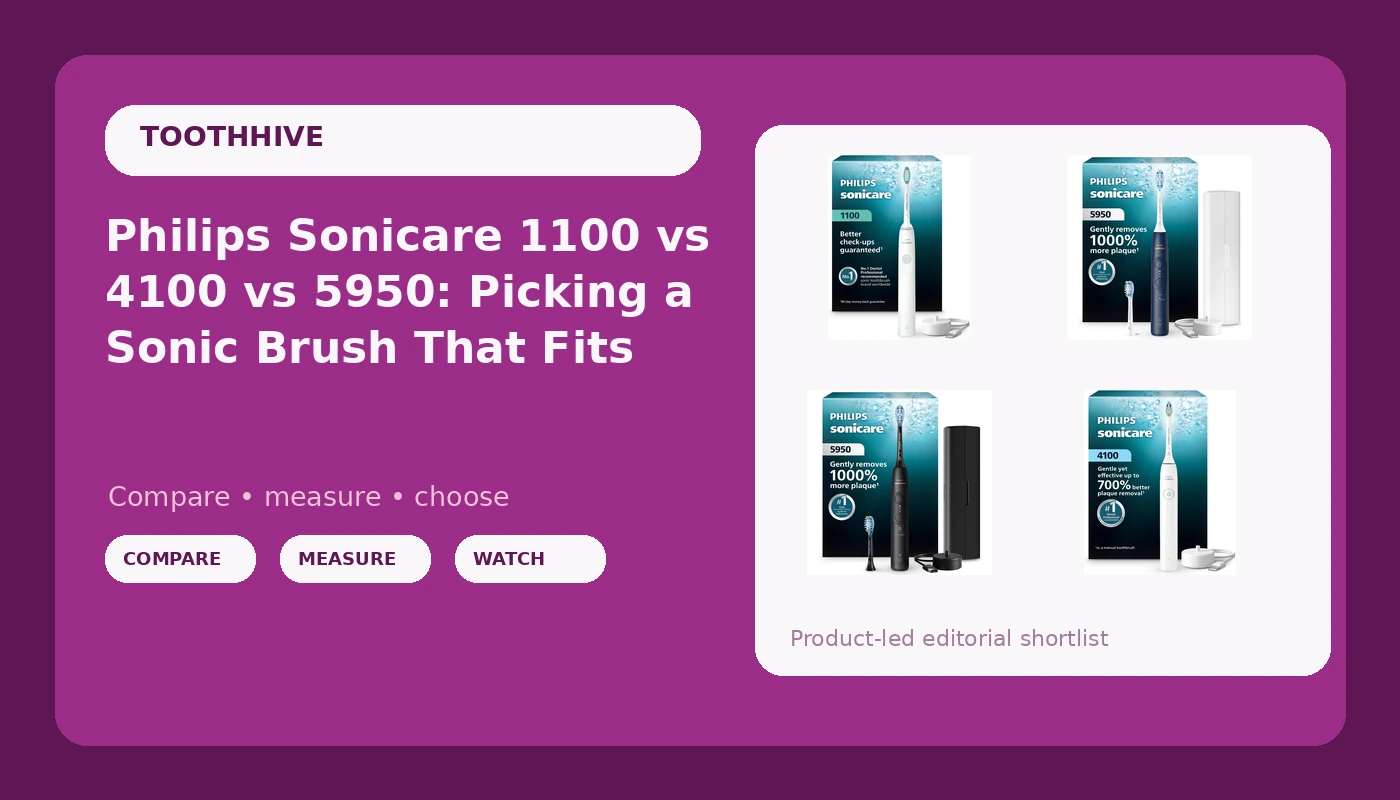
Four handles, one brand, and a spread that runs from impulse buy to a real purchase decision. That is the puzzle most people hit when they start shopping for a Philips Sonicare electric toothbrush, because the model numbers (1100, 4100, 5950) tell you almost nothing about what changes as you move up. After fourteen years of looking in mouths, I care about a short list: does it run a two-minute timer with 30-second pacing, is there a real pressure sensor, what do replacement heads cost across a year, and will you still be reaching for it in week three. This explainer walks through the four Sonicare models in this set, what each one is actually for, and how to decide without paying for features you will never touch.
Related: How to Read an Electric Toothbrush Spec Sheet: Timer, Pressure Sensor, Head Cost →
Quick answer
All four of these are rechargeable Sonicare handles from the same family, so the differences that matter to your mouth are the ones you can verify on the current product listing: a two-minute timer with 30-second quadrant pacing, a pressure sensor that warns you when you push too hard, and what replacement heads cost over the first year. If you want the middle of this set and you brush alone, the Philips Sonicare 4100 is the one I would hand most people first. If the entry point is what gets you brushing with a timer instead of a manual brush, the Sonicare 1100 covers that. If you want the step-up handle with two heads already in the box, the Sonicare 5950 in navy or black is the pair to compare.
4 useful options
| Model | Best fit | What stands out |
|---|---|---|
| Philips Sonicare 4100 Rechargeable Electric Toothbrush, 1 Brush Head, White | One person who wants the essentials without extras | Single handle, single head, the middle of this set |
| PHILIPS Sonicare 1100 Rechargeable Electric Toothbrush, 1 Brush Head, White | The lowest-commitment way into the Sonicare family | Entry model with one head in the box |
| Philips Sonicare 5950 Rechargeable Electric Toothbrush, 2 Brush Heads, Navy | A two-person household, or anyone who wants a spare head ready | Step-up handle with two heads in the box |
| Philips Sonicare 5950 Rechargeable Electric Toothbrush, 2 Brush Head, Black | The same step-up, for anyone who wants the black finish | Step-up handle with two heads in the box |
The middle pick: Philips Sonicare 4100 Rechargeable Electric Toothbrush, 1 Brush Head, White
This is the one I would start with for a single adult brushing twice a day. It is a plain handle, which is a compliment in my book: no app to pair, no modes you will never scroll to, nothing between you and two minutes of brushing. Before you buy, open the listing and confirm two things for yourself. First, that the handle runs a two-minute timer with 30-second pacing, because that interval timer is what actually gets you to the full two minutes instead of the 45 seconds most people clock on their own. Second, whether the model carries a pressure sensor, the warning that fires when you press too hard. That feature matters more than any motor spec, because brushing hard is what drives gum recession, and recession does not grow back. If both boxes are ticked on the current listing, this handle does the job.
The entry pick: PHILIPS Sonicare 1100 Rechargeable Electric Toothbrush, 1 Brush Head, White
Here is how I think about the entry model. The jump that changes your mouth is not from one power brush to a fancier power brush, it is from a manual brush to any handle that paces you for two minutes. That is the leap this one is built to make, and it is a real leap. What you give up at this end of the lineup is usually the pressure sensor and the extra modes, so if gum recession or a heavy hand is part of your story, look carefully at the listing before you commit, and consider stepping up one model. If your gums are healthy, your technique is decent, and you just want a timer and a fresh head every three months, this is a sensible place to land. Pair it with a cheap kitchen timer if the handle's own pacing is basic.
The step-up: Philips Sonicare 5950 Rechargeable Electric Toothbrush, 2 Brush Heads, Navy
Two heads in the box is not a gimmick, it is six months of brushing before you have to think about reordering, and it is the reason I would point a two-person household here rather than buying two entry handles. What I would not do is buy this expecting the handle to clean better than the model below it. Sonicare handles in a family share the same fundamental action, so the step-up usually buys you a nicer handle, more settings, and a better starting supply of heads, not a different category of clean. Check the listing for the timer behavior, the pressure sensor, and the intensity settings, and then ask whether you will actually change intensity. Most people set it once in January and never touch it again.
The step-up in black: Philips Sonicare 5950 Rechargeable Electric Toothbrush, 2 Brush Head, Black
Treat the navy and black versions as one decision with a color question attached. Buy whichever finish you will be happy looking at twice a day, because a handle you resent is a handle that ends up in a drawer. The one caution I would give on both: confirm that the brush heads you will need are the standard Sonicare click-on heads and not a proprietary variant, since head availability and head cost are the part of ownership that outlasts the purchase. If two handles in the house will share heads, buy the same family for both people so you can stock one box of replacements.
Prices and availability may change. Product images, names, and retailer links must be matched by verified ASIN. Do not state a current price, rating, stock status, or measured result without current evidence.
Why the timer and the pressure sensor decide more than the motor
Patients ask me which brush has the strongest motor. I tell them the motor is the least interesting number on the box. Two things change outcomes in a bathroom, and neither is horsepower.
The first is the quadrant timer, the pacing that nudges you every 30 seconds so you spend equal time in all four areas of your mouth. Most people who swear they brush for two minutes are done in under a minute, and they finish on the same side of the mouth every single night. A timer with 30-second intervals fixes both problems without you having to become a more disciplined person. If a handle lacks it, you are relying on willpower, and willpower loses to a warm bed at 11 p.m.
The second is the pressure sensor, the warning that tells you to ease off. Brushing hard feels productive, which is exactly why it is dangerous. Force plus bristles equals worn enamel at the gum line and gums that pull back over years, and that recession is permanent. A pressure sensor is the cheapest insurance in oral care, and it is the feature I would trade modes, app connectivity, and travel cases for.
Oscillating versus sonic is the argument people enjoy having online and it barely matters in a real mouth. Both actions remove plaque when you use them for two minutes with a decent head. Head design, head condition, and the timer matter more than which of the two motions the handle uses.
What an electric toothbrush really costs over three years
The handle is a one-time purchase. The heads are a subscription you did not know you signed up for.
A head is supposed to be replaced roughly every three months, which is four heads per person per year. Run that math against your household before you compare handles, because the gap between the cheapest and most expensive handle in this set is nothing next to three years of heads for two people. Add the heads up first, then decide how much handle you want on top.
This is also where the smart brush trap lives. A connected handle that reports your brushing to an app is not cleaning your teeth better than a plain handle with a good timer. If the app is the reason a brush costs several times what a plain handle costs, you are buying the app. And if the app exists mainly to sell you heads on a schedule, you are buying a storefront. There is nothing wrong with that if you know it, and I say this as someone who does glance at her own compliance data.
One more line item people forget: heads that cost more than the handle itself. Before you commit to any model, look up the price of a multi-pack of its heads. If a year of heads costs more than the handle did, you have your answer about which end of the lineup to shop in.
If you want a simple method, here it is:
- Confirm the handle has a two-minute timer with 30-second quadrant pacing, and cross it off the list if it does not.
- Confirm there is a real pressure sensor, especially if you have any gum recession or a heavy hand.
- Look up the cost of a four-pack of that model's replacement heads and multiply it by the number of brushers in the house.
- Decide whether you need a second head in the box or a second color, and pay only for the one you need.
- Pick the simplest handle that passes steps one and two, then commit to using it twice a day for two minutes.
How to test a new brush in the first two weeks
- Brush with the timer and do not stop early, even on the nights you are tired. The habit is the treatment.
- Let the pressure sensor do its job. If it fires, you were pressing too hard, and that is information, not an interruption.
- Stand in front of a mirror for the first week and watch where the head actually goes. Most missed plaque sits along the gum line at the back molars.
- Do not scrub in circles the way you did with a manual brush. Let the head do the work and guide it slowly along the gum line.
- Change the head at the three-month mark, not when the bristles look tired. Splayed bristles clean less and irritate more.
Which option should you choose?
Choose the Philips Sonicare 4100 Rechargeable Electric Toothbrush, 1 Brush Head, White when one person is brushing, you want a rechargeable handle with the essentials, and you would rather verify the timer and pressure sensor than pay for modes you will not use. Choose the PHILIPS Sonicare 1100 Rechargeable Electric Toothbrush, 1 Brush Head, White when the goal is simply to move off a manual brush onto a timed handle, and your gums are in good shape. Choose the Philips Sonicare 5950 Rechargeable Electric Toothbrush, 2 Brush Heads, Navy when you want the step-up handle and the second head in the box, or you are covering two brushers who will share one box of replacements. Choose the Philips Sonicare 5950 Rechargeable Electric Toothbrush, 2 Brush Head, Black when that same step-up is what you want and the black finish is the one you would rather see on the counter.
A caveat worth saying plainly: I have not published plaque scores for these four handles, and no spec sheet substitutes for the routine you keep. Treat the timer, the pressure sensor, and the head cost as the deciding evidence, and confirm each one on the current listing rather than on marketing copy.
The bottom line
The differences inside this Sonicare group come down to where you enter the lineup and how many heads arrive with the handle, not to any dramatic gap in cleaning. All four are rechargeable Sonicare handles, and the one that will do the most for your mouth is the one you will pick up twice a day for two full minutes with a fresh head every three months. Buy the simplest handle that gives you a quadrant timer and a pressure sensor, check what a year of replacement heads will cost before you commit, and put the money you save toward actually replacing those heads on schedule. That is the whole trick, and no app has improved on it yet.