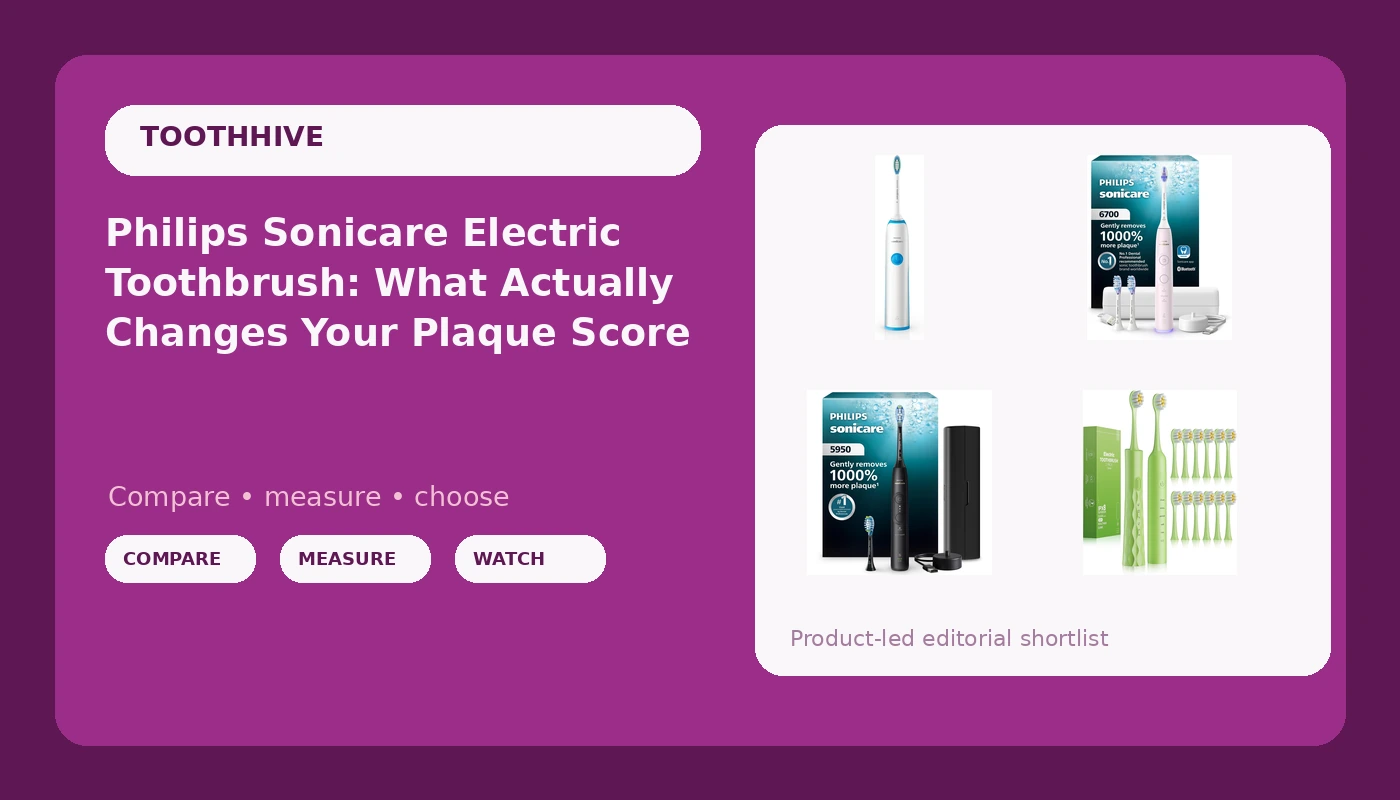
Most people who ask me which brush to buy are really asking whether they are brushing well enough. A Philips Sonicare electric toothbrush cannot answer that question, and neither can a spec sheet. What a sonic brush does is make good brushing easier to repeat: the head moves faster than your wrist can, the handle counts time for you, and on some models the handle tells you when you are leaning on your gums. The rest is habit. This explainer walks through four rechargeable sonic options, from a timer-first Philips handle to a two-pack built for a shared bathroom, and sorts out which differences show up in a plaque score and which ones are just packaging.
Related: Electric Toothbrush Timers and Pressure Sensors, Explained →
Quick answer
Choose the brush you will still be using in three months, with a head supply you can afford to replace on schedule. All four options here are rechargeable sonic toothbrushes. Two of them name a timer directly in the product name; on the other two, confirm the two-minute and 30-second interval pacing on the current listing before you commit. Beyond that, the practical differences are how many brush heads arrive in the box, how the handle charges, and whether one handle or two fits your household. None of these is the best brush for everyone, and none of them removes the need for the technique you bring to it.
Four useful options
| Model | Best fit | What stands out |
|---|---|---|
| PHILIPS Sonicare Electric Rechargeable Toothbrush Built-in Timer Mid Blue Sonic Electronic Toothbrush | A first serious sonic brush | Built-in timer in the handle; straightforward rechargeable design |
| Philips Sonicare 5950 Rechargeable Electric Toothbrush, 2 Brush Head, Black | One person stepping up in the lineup | Ships with two brush heads; black handle |
| Philips Sonicare 6700 Rechargeable Electric Toothbrush, 3 Brush Heads, Pink | Someone who wants spare heads from day one | Three brush heads in the box; pink handle |
| Aneebart 2 Pack Electric Toothbrush for Adults, USB Rechargeable Sonic Toothbrush with 12 Brush Heads, Smart Timer, 6 Modes, 2-Hour Fast Charge Last 30 Days | Two people sharing a bathroom | Two handles and 12 brush heads; USB charging; listed smart timer and six modes |
The simple Sonicare: PHILIPS Sonicare Electric Rechargeable Toothbrush Built-in Timer Mid Blue Sonic Electronic Toothbrush
Here is the argument I make in the chair most weeks: the timer is not a gimmick, it is the feature. Patients routinely tell me they brush for two minutes, and when I time them it is closer to forty-five seconds. A handle that counts the time fixes a problem no motor upgrade can reach. This Philips handle keeps things simple, and the trade-off is the same one you get with any stripped-down model: the product name tells you there is a timer, and it does not tell you whether there is a pressure sensor or how many brushing modes exist. Read the listing for those details before you buy, especially if your hygienist has mentioned that you brush hard.
The two-head step-up: Philips Sonicare 5950 Rechargeable Electric Toothbrush, 2 Brush Head, Black
The model name gives you the head count and the color and stops there. Mode count, charging style, and whether a pressure sensor is included are the details worth opening the listing to find, because those are the things you notice every morning. Two heads is a sensible starting supply: enough runway to get past the honeymoon phase, not so many that you are storing a drawer of them. If you are moving up from a basic handle, the honest question is whether the extra features on this one are features you will use, or whether you are paying for a menu you will scroll past at 6:40 in the morning.
The three-head step-up: Philips Sonicare 6700 Rechargeable Electric Toothbrush, 3 Brush Heads, Pink
Head count matters more than people expect, because on most electric toothbrushes the heads are the recurring expense and the handle is the one-time purchase. A box that starts you with three covers roughly nine months at the three-month swap. The color matters too, more than a spec sheet admits: a brush that lives on the counter in a color you actually like is a brush you are less likely to leave in a drawer. If two people in the house want this model, buy two handles rather than sharing one, and keep the heads distinct so nobody has to guess whose is whose.
The two-person bundle: Aneebart 2 Pack Electric Toothbrush for Adults, USB Rechargeable Sonic Toothbrush with 12 Brush Heads, Smart Timer, 6 Modes, 2-Hour Fast Charge Last 30 Days
Two handles and twelve heads is a lot of supply, and it changes the math on the thing that actually costs money over time: the heads. The trade-offs are the ones that come with any multi-pack. Two handles means two charging habits to keep straight, six modes is more than most adults will ever touch, and a bundle is only a bargain if the handles feel right in your hand and replacement heads stay easy to find once the twelve are gone. Treat the 30-day runtime as the manufacturer's claim and verify it on the current listing rather than taking it as measured fact.
Prices and availability may change. Product images, names, and retailer links are matched to verified listings. No current price, rating, stock status, or measured result is stated here without current evidence.
What a quadrant timer actually changes
Two minutes, twice a day, is the recommendation nearly every dental organization lands on, and the timer exists because almost nobody hits that by feel. A quadrant timer splits those two minutes into four 30-second blocks and signals when to move to the next section of your mouth. That is the whole trick, and it works. The pacing does two things at once: it stretches brushing out to the full two minutes, and it stops you from spending ninety seconds on the front teeth you can see in the mirror and thirty on the molars at the back, where most decay starts.
This is also why I care much less about motor type than the marketing suggests. Oscillating brushes spin a round head back and forth; sonic brushes vibrate a longer head at high frequency. Both approaches remove plaque when the head stays on the tooth long enough. What separates a good session from a bad one is coverage and time, and the timer is the part of the brush that manages both without your input. A handle without interval pacing is still usable. It just asks you to be the timer, and most of us are bad at that.
Pressure, brush heads, and the recurring cost
Brushing too hard is the most common self-inflicted problem I see. It does not make teeth cleaner. It wears enamel at the gum line and pushes gums back, and recession does not grow back. A pressure sensor is the one piece of toothbrush technology that consistently changes outcomes for people with a heavy hand, because it gives feedback in the moment instead of a lecture at your next cleaning. If your gums are already receding or your hygienist has mentioned your brushing force, put that sensor near the top of your checklist, ahead of mode count and app features.
Brush head supply is the second thing worth planning. Heads are meant to be replaced about every three months, which is four heads per person per year. For most electric toothbrushes the heads are the recurring expense and the handle is the one-time purchase, so look at how many heads arrive in the box and what a replacement pack goes for. A handle that ships with three heads has covered most of a year. A bundle with twelve has covered years, at least on paper.
Apps deserve a short paragraph. A connected brush can show you a map of where you missed, and I will admit that compliance data is interesting. But an app that exists mainly to sell you heads on a schedule is not a cleaning feature. Buy the timer and the pressure sensor; treat the app as a bonus.
- Confirm the timer and its interval pacing on the listing before anything else.
- Decide how many people will use the brush, because a shared handle is a hygiene problem, not a savings plan.
- Count the brush heads in the box and check what a replacement pack costs.
- Check how it charges and where it will live on your counter.
- Read the mode list and ask honestly whether you will use more than one of them.
Practical guidance for the first two weeks
- Charge the handle the day it arrives so your first session is not a half-charged one.
- Use it at the two times you already brush, because the habit matters more than the upgrade.
- Let the timer run to the end even when you are in a hurry, at least for the first week.
- Watch for pressure feedback and loosen your grip until you can hold the handle with two fingers.
- Write the start date on your calendar so the three-month head swap is not a guess.
Which option should you choose?
Choose the PHILIPS Sonicare Electric Rechargeable Toothbrush with the built-in timer when you want the simplest rechargeable sonic handle and the timer is the feature you care about. Choose the Philips Sonicare 5950 when one person is brushing and two heads in the box is the right starter supply. Choose the Philips Sonicare 6700 when you want three heads from day one and a handle color you will not mind leaving out. Choose the Aneebart 2 Pack when two people share a bathroom and you want USB charging plus a long runway of brush heads.
One caveat before you click. Nothing in a model name tells you how a handle will feel in your hand or whether its mode menu suits your gums. Names list head counts and colors; they rarely list pressure sensors or charging styles, and those are the details that decide whether you keep using the brush. Open the current listing for the model you are considering, confirm the timer and sensor features, and check the replacement head price before you commit. If you have active gum disease, significant recession, or a lot of restorative work, the brush is the smaller half of the conversation. Talk to your dentist or hygienist about what your mouth specifically needs.
The bottom line
An electric toothbrush is a tool for a habit, not a substitute for one. The features that move a plaque score are the ones that keep you honest: a two-minute timer with 30-second pacing, a pressure sensor if you brush hard, and a supply of fresh heads you will actually swap on schedule. Everything else, from mode counts to apps to colorways, is preference, and preference is not nothing. The brush that stays on your counter and gets used twice a day beats the one that impressed you at checkout. Pick the handle that fits your household and your routine, confirm the timer and sensor details on the listing, and plan the head supply before you need it.