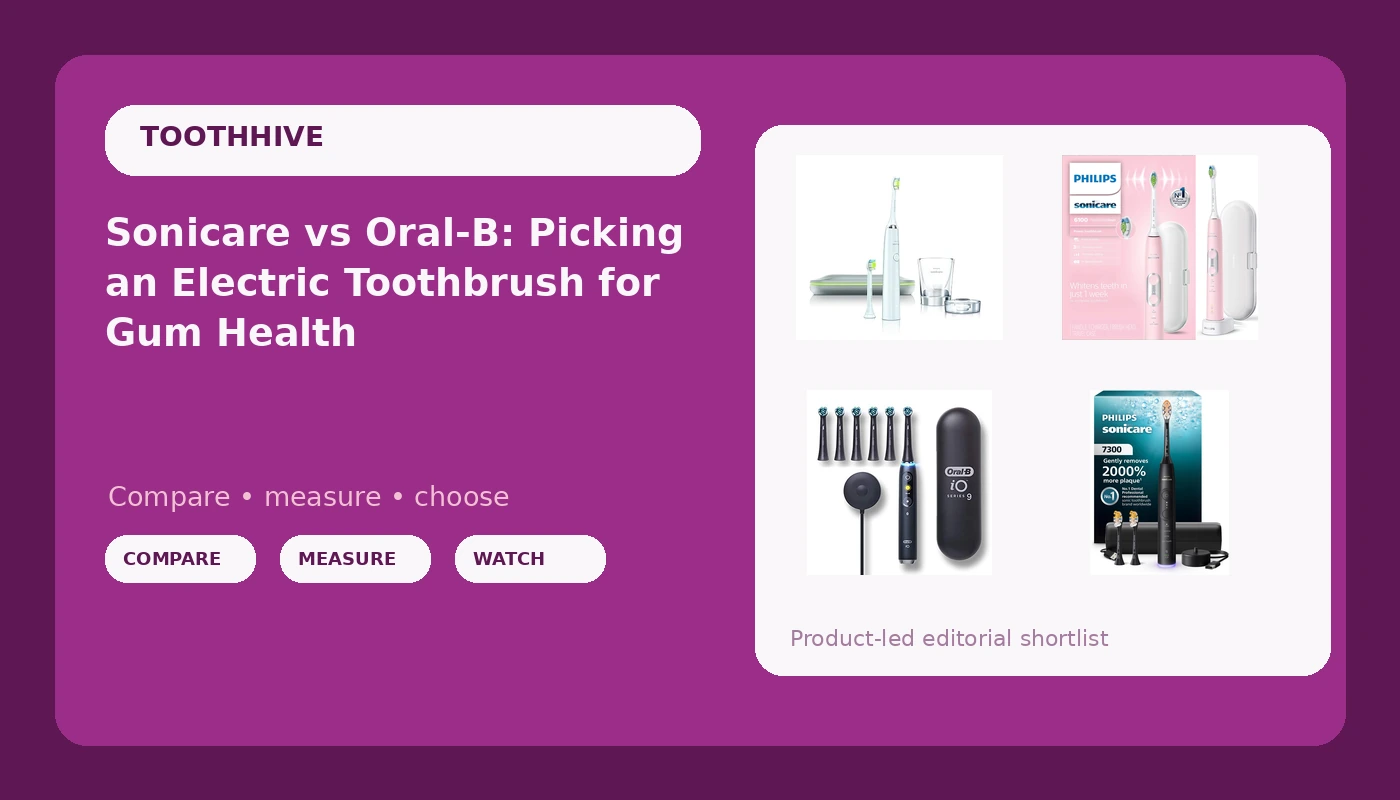
If you are shopping for an electric toothbrush for gum health, the noise gets loud fast. Two brands own most of the shelf, each one sells brushes at four or five price points, and the gap between the top of one line and the middle of the other is narrower than the price tags suggest. The features that change outcomes are unglamorous: a two-minute timer with 30-second quadrant pacing, a pressure sensor that tells you when you are pressing too hard, and a brush head you will actually replace on schedule. Everything above that is comfort, convenience, or software.
This guide compares four rechargeable brushes that represent four different answers to the same question. Three use sonic vibration and one uses a round oscillating-rotating head, they ship with different numbers of brush heads, and they offer different amounts of feedback while you brush. None of them fixes technique. All of them can support good technique.
Related: How to Use a Pressure Sensor Without Overthinking It →
Quick answer
Buy the brush you will use twice a day for two minutes, and treat the quadrant timer and the pressure sensor as the non-negotiables. Among these four, the Philips Sonicare DiamondClean is the most fully equipped Sonicare in the group, the Oral-B iO Series 9 is the one with the most gum-focused feedback built into the handle, the Philips Sonicare 6100 keeps the essentials with the least complexity, and the Philips Sonicare 7300 sits in the middle of the Sonicare range and includes three brush heads. The real differences among them come down to motor style, feedback features, and what ships in the box.
Four useful options
| Model | Best fit | What stands out |
|---|---|---|
| Philips Sonicare DiamondClean rechargeable electric toothbrush, White Edition, HX9332 | Anyone who wants the full Sonicare feature set in one handle | Sonic handle with a pressure sensor, multiple cleaning modes, and a charging glass plus travel case |
| Oral-B iO Series 9 Electric Toothbrush With 6 Brush Heads, Black Onyx | People whose priority is gum health feedback while brushing | Round oscillating-rotating head, pressure feedback, interactive display, six brush heads included |
| Philips Sonicare 6100 Rechargeable Electric Toothbrush, 1 Brush Head, Pink | First electric brush and simpler routines | Sonic handle with a pressure sensor and quadrant timer, one brush head in the box |
| Philips Sonicare 7300 Rechargeable Electric Toothbrush, 3 Brush Head, Black | Households that want spare heads from day one | Sonic handle with a pressure sensor, three brush heads included, black handle |
The full-featured option: Philips Sonicare DiamondClean rechargeable electric toothbrush, White Edition, HX9332
The trade-off here is cost at both ends of ownership. The handle is the premium entry in this group, and the replacement heads are the recurring expense on every electric brush, so the long-run price depends on how faithfully you swap heads rather than on the handle alone. If the charging glass, the travel case, and the extra modes are things you will actually use, the premium buys convenience you will notice. If you plan to leave the brush on its default setting for the next three years, a simpler handle in the same line does the same daily job.
The gum-health option: Oral-B iO Series 9 Electric Toothbrush With 6 Brush Heads, Black Onyx
The honest caveat about the iO Series 9 is that a meaningful share of what you pay for lives in software. The coaching and the app are genuinely useful if you are the kind of person who checks data, and genuinely ignorable if you are not. Strip the app away and you still have a strong oscillating-rotating brush with pressure feedback and a timer, which is the part that cleans teeth. If you know you will never open the app, you are paying for a display you will not read, and a mid-range Oral-B would do the same mechanical work.
The simpler option: Philips Sonicare 6100 Rechargeable Electric Toothbrush, 1 Brush Head, Pink
Because only one head ships in the box, this is the option where you will be buying replacements soonest. That is not a flaw so much as a budgeting detail: the head is the part that wears out and the part that touches your gums, so plan on a standing supply either way. What you give up relative to the DiamondClean is the presentation and the mode list. What you keep is the timer and the pressure sensor, which are the two features most likely to change how your gums look at your next cleaning.
The middle option: Philips Sonicare 7300 Rechargeable Electric Toothbrush, 3 Brush Head, Black
The three included heads are the practical argument for this brush. Over a year you will go through several heads no matter which handle you buy, so starting with three spreads that cost out instead of concentrating it in the first month. The trade-off is that the 7300 is neither the cheapest nor the most feature-loaded option here, which makes it the pick for someone who has decided they want a Sonicare and does not want to think about the decision again for a while.
Prices and availability may change. Product images, names, and retailer links are matched to verified listings. No current price, rating, stock status, or measured result is stated here without current evidence.
Sonic vibration versus oscillating-rotating
The two motor styles in this group work differently and both work. Sonicare handles vibrate the bristles at high frequency, and the motion is designed to move fluid around the gum line as well as scrub the tooth surface. Oral-B handles spin a small round head back and forth with a pulsing motion, and the round head is shaped to cup one tooth at a time as you walk it along the gum line. You will find strong clinical literature behind both approaches, and you will also find that the brand you learned on tends to feel more natural years later.
What matters more than the motor is the head. A worn, splayed brush head cannot clean well no matter what drives it, and a head that is too large for your mouth cannot reach the back molars where plaque accumulates quietly. When you compare brushes, compare the cost and availability of their heads and the size options they come in. That is the part of the system you will interact with every day, and it is the part that determines whether the brush was a good purchase or an expensive one.
Why the pressure sensor and the quadrant timer matter
Gum recession is usually not caused by skipping brushing. It is caused by brushing hard, often in the same spots, with a brush that has lost its bristles. A pressure sensor interrupts that pattern by telling you in the moment that you are pushing too hard, which is information you cannot get from feel alone, because pressure feels normal when it is your habit. Every brush in this group includes one, and that is the single most protective feature on the list.
The quadrant timer solves a different problem. Most people brush the front teeth for well over a minute and the back corners for a few seconds, then stop. A timer that pulses every 30 seconds moves you around the mouth in four equal blocks and keeps the total at two minutes, which is the duration most guidance settles on. Neither feature makes brushing automatic, but both make the correct behavior easier to repeat, and repetition is what changes a mouth over months.
- Confirm the brush has a two-minute timer with 30-second quadrant pacing. Without it, the rest of the feature list is decoration.
- Confirm there is a pressure sensor. This is the feature that protects gums from recession.
- Count the brush heads in the box and look up the cost of replacements before you buy.
- Decide honestly whether you will use an app and a display, or whether you will ignore them.
- Match the handle to your routine: travel case, charger type, color, and how it sits on your counter.
Practical guidance before you order
- Replace the brush head on the schedule the manufacturer specifies, usually around three months or sooner if the bristles splay.
- Let the pressure sensor do its job. If it fires, ease off rather than finishing the stroke with the same force.
- Use the quadrant pacing to reach the back molars, which are the teeth most people under-brush.
- Keep one spare head on hand so a worn head never becomes a reason to skip a brushing session.
- Treat the app as optional. If the coaching helps you keep a two-minute habit, use it. If it does not, the timer still works.
- Store the handle somewhere it can dry. A damp brush head is a hygiene problem, not a cleaning one.
Which option should you choose?
Choose the Philips Sonicare DiamondClean rechargeable electric toothbrush, White Edition, HX9332 when you want the most complete Sonicare package here and you value the charging glass, the travel case, and the mode options. Choose the Oral-B iO Series 9 Electric Toothbrush With 6 Brush Heads, Black Onyx when gum-health feedback is your priority, you like the round oscillating-rotating head, and you will use the display and app rather than ignore them. Choose the Philips Sonicare 6100 Rechargeable Electric Toothbrush, 1 Brush Head, Pink when you want the timer and the pressure sensor at the lowest complexity and you are fine buying heads as you go. Choose the Philips Sonicare 7300 Rechargeable Electric Toothbrush, 3 Brush Head, Black when you want a mid-range Sonicare and would rather start with three heads in the box.
One caveat applies to all four. This comparison is based on the features each brush is built around, not on a plaque score measured in your mouth. Cleaning outcomes depend on technique, on how often you replace the head, and on how consistently you brush, which no handle can supply on your own behalf.
The bottom line
The electric toothbrush that protects your gums is the one with a quadrant timer and a pressure sensor that you will actually pick up twice a day. All four brushes here clear that bar, so the choice comes down to motor style, feedback, and what ships in the box. If you want the fullest Sonicare, look at the DiamondClean. If gum-health feedback is the goal, look at the iO Series 9. If simplicity and lower complexity matter more, the 6100 and the 7300 cover the middle of the range with three heads or one. Whichever you pick, spend your attention on technique, head replacement, and a lighter hand on the brush.