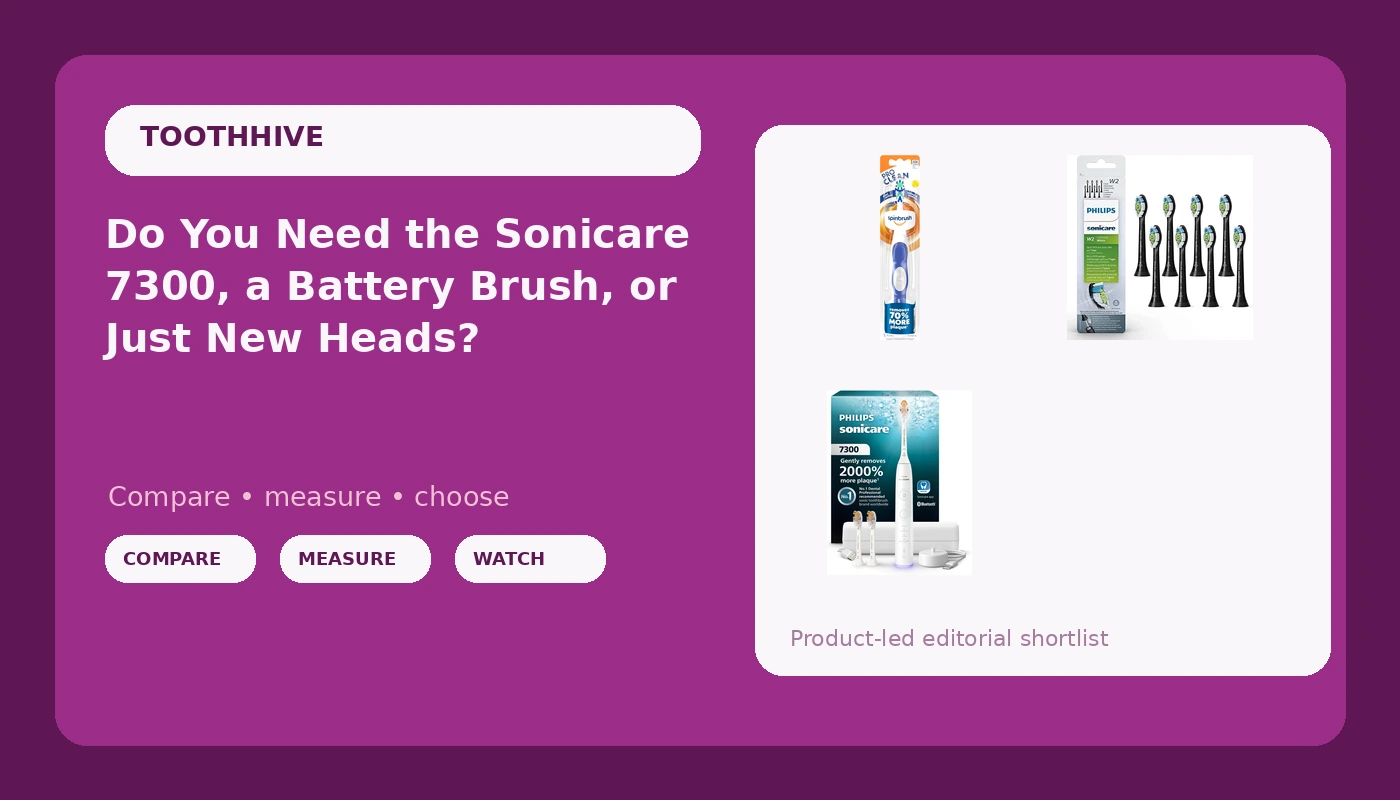
Most people shopping for an electric toothbrush end up comparing motors, modes, and app screens while the two things that actually decide their gum health sit ignored: whether the brush has a two-minute timer with 30-second quadrant pacing, and whether they will still be using it three months from now. This electric toothbrush buying guide works through three different pieces of a routine that holds up, a rechargeable Sonicare handle, a battery-powered brush that asks far less of your budget, and the replacement heads that keep a sonic handle doing its job. None of them is a magic upgrade on its own. Matched to the right person, each one solves a problem the others do not.
Related: How Often Should You Replace a Toothbrush Head? →
Quick answer
Start with the routine, then buy the handle. If you will brush for two minutes twice a day and you want pressure feedback without thinking about batteries, a rechargeable sonic brush such as the Philips Sonicare 7300 is the straightforward route, and it arrives with three brush heads so you are not buying refills the same week. If you want powered brushing with the least setup and the least upkeep, the Spinbrush PRO CLEAN runs on batteries and skips the charging dock entirely. Whichever handle you choose, plan for the consumables: the W2 Optimal White eight-pack is the refill that keeps a Sonicare handle working the way it was designed to. A worn brush head is the most common reason a perfectly good toothbrush quietly stops cleaning well.
3 useful options
| Model | Best fit | What stands out |
|---|---|---|
| Philips Sonicare 7300 Rechargeable Electric Toothbrush, 3 Brush Head, White | Brushing at home with a dock and a timer | Rechargeable sonic handle that ships with three brush heads |
| Spinbrush PRO CLEAN Battery Powered Toothbrush, Soft Bristles, 1 Count, Gold or Blue Color May Vary | Simple powered brushing without a charger | Battery powered with soft bristles; color varies between gold and blue |
| Philips Sonicare Original W2 Optimal White Standard Sonic Toothbrush Heads, 8 Pack in Black (Model HX6068/13) | Anyone already using a Sonicare handle | Eight standard-size replacement heads with the snap-on fitting |
The rechargeable option: Philips Sonicare 7300 Rechargeable Electric Toothbrush, 3 Brush Head, White
The case for a rechargeable handle is mostly about friction. A dock on the counter means the brush is charged, in reach, and ready, and the timer that runs the two-minute cycle is built into the handle rather than left to your phone. Sonicare's rechargeable platform is built around sonic vibration, and the models in this range are designed to give you a quadrant timer plus pressure feedback, the two features that do the most work on gum health. Pressure feedback matters more than most buyers expect: brushing hard is what drives gum recession, and a handle that tells you when you are pushing too hard is doing preventive work every single time you brush. The trade-off is the charging base, the higher upfront cost than a battery brush, and the fact that the ongoing expense lives in the refill heads rather than the handle. The 7300 softens that last point by including three heads, which is roughly nine months of brushing for one person at the standard replacement interval.
The battery-powered option: Spinbrush PRO CLEAN Battery Powered Toothbrush, Soft Bristles, 1 Count, Gold or Blue Color May Vary
This is the least complicated route into powered brushing. There is no dock, no charging cable, no wall outlet commitment, which makes it a reasonable fit for a guest bathroom, a travel bag, a dorm, or anyone who knows they will not keep a charger on the counter. The honest trade-offs are the ones that come with every battery brush. Power output depends on the condition of the cells, and output can taper as they drain, so a fresh set of batteries is part of the routine rather than an occasional errand. Batteries also become a recurring cost and a small disposal question. Before you commit, check how the replacement heads work for the specific model you receive, because a powered brush with a head you cannot replace cheaply turns into a disposable handle. Two more practical notes: soft bristles are the right default for most adults, and the color is not selectable here, so the listing ships gold or blue at the retailer's discretion.
The refill heads: Philips Sonicare Original W2 Optimal White Standard Sonic Toothbrush Heads, 8 Pack in Black (Model HX6068/13)
Nobody gets excited about brush heads, and they are the reason most electric toothbrushes stop working well. Bristles splay, the tips round off, and a head that has been in service well past its interval contacts the tooth surface differently than it did when it was new. The usual clinical guidance is to replace a head about every three months, sooner if the bristles are visibly bent or if you have been sick. An eight-pack covers roughly two years for a single user at that interval, which turns a recurring annoyance into one purchase. Standard-size heads like these fit Sonicare handles that accept the snap-on fitting, including rechargeable models in the Sonicare range. Two things to verify before ordering: that your handle uses the standard snap-on connection rather than a different mount, and that you are comfortable with black heads, since this pack does not come in white.
Prices and availability may change. Product images, names, and retailer links are matched to verified listings. No current price, rating, stock status, or measured result is stated here without current evidence.
What actually moves your plaque score
Plaque removal is not mysterious. It is coverage, time, and pressure, in that order, and every one of those is a habit rather than a feature.
Coverage is where most people lose points. The brush head has to reach the gumline and the back of the last molar on each side, and that means the head has to be small enough to get there and angled so the bristles meet the gum margin rather than sitting flat on the crown of the tooth. This is why a timer with 30-second quadrant pacing is the single most useful piece of technology on a modern handle. It does not clean anything by itself, but it forces you to spend equal time in each quarter of your mouth, which is exactly where the missed zones live. Without pacing, almost everyone over-brushes the front teeth and under-brushes the molars on their non-dominant side.
Pressure is the second lever, and it is the one that causes damage rather than just missing it. Scrubbing hard does not remove more plaque; it wears enamel at the gumline and pushes the gum tissue back over time. A pressure sensor gives you a signal you cannot feel on your own, because brushing too hard feels like brushing thoroughly. If a handle lacks pressure feedback, you have to consciously hold the brush with two fingers and let the motor do the work.
Time is the easiest to fix and the most commonly skipped. Two minutes, twice a day, with a real timer, beats four minutes of aggressive scrubbing every time.
Sonic, oscillating, and battery brushes: what the difference means in your mouth
Motor type gets more attention than it deserves. Sonic brushes vibrate the bristles at high frequency; oscillating brushes rotate a round head back and forth. Both approaches remove plaque effectively when the head reaches the right places and you brush for the full two minutes. Head design, head condition, and habit matter more than which of the two motions your handle uses, which is why an inexpensive brush used correctly will outperform an expensive one used badly. Battery-powered brushes sit a step below rechargeable ones on consistency, mainly because output depends on the state of the cells, but a battery brush that gets used twice a day still beats a rechargeable one that sits in a drawer. Use this order of operations before you buy:
- Confirm the handle has a two-minute timer with 30-second quadrant intervals. If it does not, keep looking.
- Confirm there is pressure feedback, or commit to a light two-finger grip if there is not.
- Decide how you want to power it: a dock on the counter, or batteries you replace yourself.
- Price the first year, not the handle. Add up replacement heads or batteries over twelve months.
- Pick the one you will genuinely keep within arm's reach of the sink and use twice a day.
Setting up a routine that survives past week three
- Put the brush and charger where you already stand, not in a cabinet. Visibility drives compliance more than motivation does.
- Write the head-change date on the calendar when you install a new head, so replacement is a scheduled event rather than a guess.
- Hold the head at a slight angle toward the gumline and move it slowly along each tooth instead of scrubbing in circles.
- Let the motor do the work. Light pressure, full contact, and a full two minutes is the whole method.
- Keep one spare head or one spare set of batteries on hand, so a worn head or a dead cell never becomes a reason to skip a brushing.
Which option should you choose?
Choose the Philips Sonicare 7300 Rechargeable Electric Toothbrush, 3 Brush Head, White when you brush at home twice a day, you want a quadrant timer and pressure feedback, and you would rather charge a handle than shop for batteries. Choose the Spinbrush PRO CLEAN Battery Powered Toothbrush, Soft Bristles, 1 Count, Gold or Blue Color May Vary when you want powered brushing with no dock, no cable, and minimal setup, or when the brush lives somewhere a charger would be inconvenient. Choose the Philips Sonicare Original W2 Optimal White Standard Sonic Toothbrush Heads, 8 Pack in Black (Model HX6068/13) when you already own a Sonicare handle with the standard snap-on fitting and your current head is past its interval.
One limit worth naming: this article describes products from their listings and from general brushing principles. It does not report a measured plaque score for any of them, and no handle here has been ranked as quietest, fastest, or best. Fit, hand feel, and noise are personal, and the only way to judge them is to hold the brush. Prices, availability, and bundle contents change, so confirm the current listing details before you order, especially the color and the number of heads included.
The bottom line
The toothbrush is the smallest part of the decision. A handle with a two-minute timer and 30-second pacing, a head that is replaced on schedule, and a light grip that lets the motor work will do more for your gums than any upgrade in motor technology. If you want the rechargeable route, the Sonicare 7300 gives you a dock, a sonic handle, and three heads to start with. If you want the simple route, the Spinbrush PRO CLEAN runs on batteries and asks nothing of your counter space. And if you already have a Sonicare handle, the eight-pack of W2 heads is the purchase that keeps it working, which is usually the most cost-effective thing you can do for your brushing routine. Check current Amazon price on whichever piece you are missing, and replace the head before the bristles tell you to.