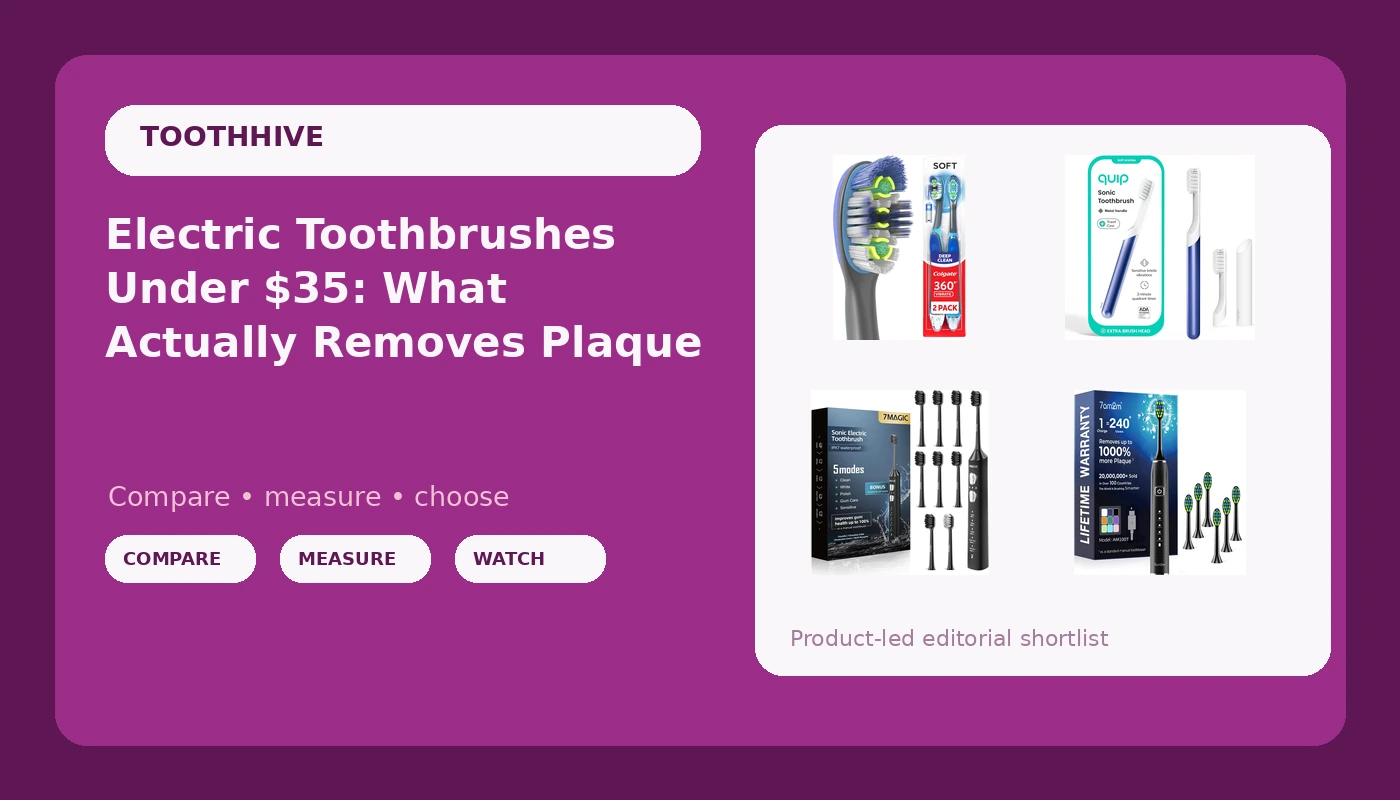
Most people shopping for affordable electric toothbrushes are not really choosing between features. They are choosing between a brush they will still be using three months from now and one that ends up in a drawer next to a dead charger. I have spent fourteen years as a dental hygienist in Madison, Wisconsin, and the mouths I see tell the same story every time: technique and consistency matter more than the motor. A two-minute timer with 30-second intervals and a soft, replaceable head do more for your gums than any app ever will. That is why these four brushes belong in one conversation. They run from a manual floss-tip brush to three sonics, and the differences between them are mostly about habits, not horsepower.
Related: How to Build a Two-Minute Brushing Habit That Actually Sticks →
Quick answer
Buy the brush whose timer you will actually obey and whose heads you will actually replace. A two-minute timer with 30-second quadrant intervals is the feature that separates a serious toothbrush from a spinning handle, and a soft replaceable head is what does the cleaning. If you want the simplest tool that works, the Colgate 360 Advanced Floss Tip Soft Toothbrush is a manual brush with a floss-tip head, and it arrives two to a pack. If you want a motor, the Quip, the 7MAGIC, and the 7AM2M are all sonic brushes, and they differ mainly in runtime, charging method, and how many heads come in the box.
Four useful options
| Model | Best fit | What stands out |
|---|---|---|
| Colgate 360 Advanced Floss Tip Soft Toothbrush, 2 Pack | Manual brushing, travel, or a bathroom backup | Floss-tip head design, soft bristles, two brushes per pack |
| Quip Sonic Electric Toothbrush, Extra Brush Head, Metal Handle, Indigo | A slim, simple sonic with a refill system | Metal handle, sonic motor, extra brush head included |
| 7MAGIC Sonic Electric Toothbrush, 180-Day Runtime, 42000VPM, 8 Heads, Black | Going a long time between charges and reorders | 180-day rated runtime, 42,000 VPM motor, eight brush heads included |
| 7AM2M Sonic Electric Toothbrush for Adults, Type-C Charging Run for 120 Days | Standard cable charging instead of a dock | Type-C charging, 120-day rated runtime |
The manual alternative: Colgate 360 Advanced Floss Tip Soft Toothbrush, 2 Pack
A manual brush has one advantage no electric can match: there is nothing to charge, nothing to lose in a hotel room, and nothing to break. The trade-off is that you supply the timing and you supply the pressure, and those are exactly the two things people get wrong. Without a timer, brushing time tends to shrink quietly, and without a pressure sensor, hard brushing keeps feeling like thorough brushing right up until the gums start receding. If you choose this route, treat the timer on your phone as part of the toothbrush. Two minutes, twice a day, light pressure, and a fresh head every three months.
The simple sonic: Quip Sonic Electric Toothbrush, Extra Brush Head, Metal Handle, Indigo
Quip's whole idea is that you should not have to think about your toothbrush. The handle is thin, the design is quiet in the visual sense, and replacement heads arrive through a subscription, which is either the most convenient part of the system or the most irritating, depending on your temperament. The honest trade-off is that this is a modest sonic motor in a nice handle rather than a clinical powerhouse, and the subscription is a recurring cost you should price out before you commit. If your history is "I buy a fancy brush and then stop using it," the simplicity is a feature. If your history is gum inflammation and heavy plaque, look at the timer and pressure features first.
The long-runtime pick: 7MAGIC Sonic Electric Toothbrush, 180-Day Runtime, 42000VPM, 8 Heads, Black
Runtime ratings are manufacturer figures measured under particular conditions, so treat "180 days" as a ceiling rather than a promise, and expect it to shorten if you use the strongest mode or brush longer than two minutes. The bigger practical point is the head count. Eight heads at roughly one every three months covers about two years of brushing, which removes the single most common reason people abandon an electric brush: they run out of heads, the replacement costs more than they expected, and the handle goes in a drawer. The 42,000 VPM figure is worth reading carefully. Vibration speed is a motor spec, not a cleaning result, and a fast motor with a worn head cleans worse than a slow one with a fresh head.
The USB-C pick: 7AM2M Sonic Electric Toothbrush for Adults, Type-C Charging Run for 120 Days
Type-C charging sounds like a small detail until you have owned a brush with a proprietary two-pin dock that you cannot replace and cannot travel with. A standard cable means one charger for your phone, your laptop, and your toothbrush, and it means a lost charger is a solved problem. The 120-day runtime figure is again a rated number, and it will vary with mode and usage. What this brush does not promise is the same head supply as the 7MAGIC, so check how many heads come in the box before you decide, and price the refills either way. The deciding question with any of these sonics is not the motor. It is whether the head is soft, whether it fits your mouth, and whether you will replace it on schedule.
Prices and availability may change. Product images, names, and retailer links are matched to verified listings. No current price, rating, stock status, or measured result is stated here without current evidence.
Why the timer matters more than the motor
The most useful feature on any electric toothbrush costs almost nothing to add, which is why it is frustrating that some expensive brushes still ship without a proper version of it. A two-minute timer with 30-second quadrant intervals does three things at once. It tells you when to move to the next section of your mouth, it stops you from spending ninety seconds on the front teeth you can see and skipping the molars you cannot, and it ends the brush at two minutes so you do not scrub for four. People who brush without a timer are not lazy. They are simply bad at estimating time, which is a universal human trait rather than a character flaw.
The motor type debate gets more attention than it deserves. Oscillating brushes spin a round head back and forth. Sonic brushes vibrate a rectangular head at high frequency. Both approaches remove plaque when they are used with a soft head, light pressure, and enough time. What actually changes outcomes is the head. A soft, splayed-free head reaches under the gum line and along the margins without gouging the tissue, and a worn head stops cleaning long before it looks worn out. If you have to choose between a premium motor with a tired head and a basic motor with a fresh one, take the fresh head every time.
What the spec sheet does not tell you
Specification lists love big numbers, and the three that show up most are vibration speed, battery runtime, and head count. None of them is a cleaning measurement. Vibration speed describes the motor, not the plaque removal. Runtime is rated under conditions you may not reproduce, and it usually shortens as the battery ages. Head count is genuinely useful, but only if the heads fit well and you actually swap them on schedule. The number that matters most to your wallet never appears on the box at all: what a year of replacement heads costs compared with the price of the handle.
Here is the order I would use to evaluate any brush, including these four.
- Confirm the brush has a two-minute timer with 30-second quadrant intervals. If it does not, it is a handle with a motor, not a serious toothbrush.
- Check that the head is soft and replaceable, and find out what replacement heads cost over twelve months, not just what the handle costs today.
- Look for a real pressure sensor if you have any history of receding gums or sensitive teeth. Brushing hard does more damage than brushing briefly.
- Decide how you want to charge it. A standard cable you already own beats a proprietary dock you will lose, and a long rated runtime beats both.
- Count the heads in the box, divide by four, and ask whether that gets you to a point where reordering feels routine rather than like a chore.
How to keep the brush working past month three
- Brush for two minutes, twice a day, with light pressure. The timer is the habit, and the habit is the outcome.
- Replace the head every three months, or sooner if the bristles are splayed or discolored. A worn head is the most common reason an electric brush stops working well.
- Do not press harder to compensate for an old head. Pressure does not restore cleaning power, it just adds gum recession.
- Keep a manual brush for travel, power outages, and the mornings when the battery is dead. The Colgate two-pack makes that easy.
- Charge before the battery is fully flat if you can, and keep the charger somewhere you will see it rather than in a drawer.
Which option should you choose?
Choose the Colgate 360 Advanced Floss Tip Soft Toothbrush, 2 Pack when you want a reliable manual brush with a floss-tip head, or when you need a travel and backup brush to sit alongside an electric one. Choose the Quip Sonic Electric Toothbrush, Extra Brush Head, Metal Handle, Indigo when you want a slim, simple sonic and you like the idea of heads arriving on a schedule instead of being remembered. Choose the 7MAGIC Sonic Electric Toothbrush, 180-Day Runtime, 42000VPM, 8 Heads, Black when you want a long stretch between charges and you do not want to think about replacement heads for a long time. Choose the 7AM2M Sonic Electric Toothbrush for Adults, Type-C Charging Run for 120 Days when standard cable charging matters to you and you want a long rated runtime without a dock.
One caveat applies to all four. The feature lists come from the manufacturers, and no listing can tell you whether a head will feel comfortable in your mouth or whether the timer will annoy you into ignoring it. Buy the one whose trade-offs match your actual habits, then judge it after a month of real use rather than a week of novelty.
The bottom line
The best toothbrush for you is the one you will use for two minutes, twice a day, with a soft head and light pressure. Everything else is detail. If you want to skip the motor entirely, the Colgate 360 Advanced Floss Tip Soft Toothbrush gives you two soft floss-tip brushes in one pack and no charging to think about. If you want a sonic brush, the Quip is the simplest, the 7MAGIC carries the longest rated runtime and the largest head supply, and the 7AM2M charges over Type-C with a long rated runtime of its own. Pick the one that fits how you already live, set a reminder to change the head, and stop shopping. Your gums will not care which logo is on the handle.