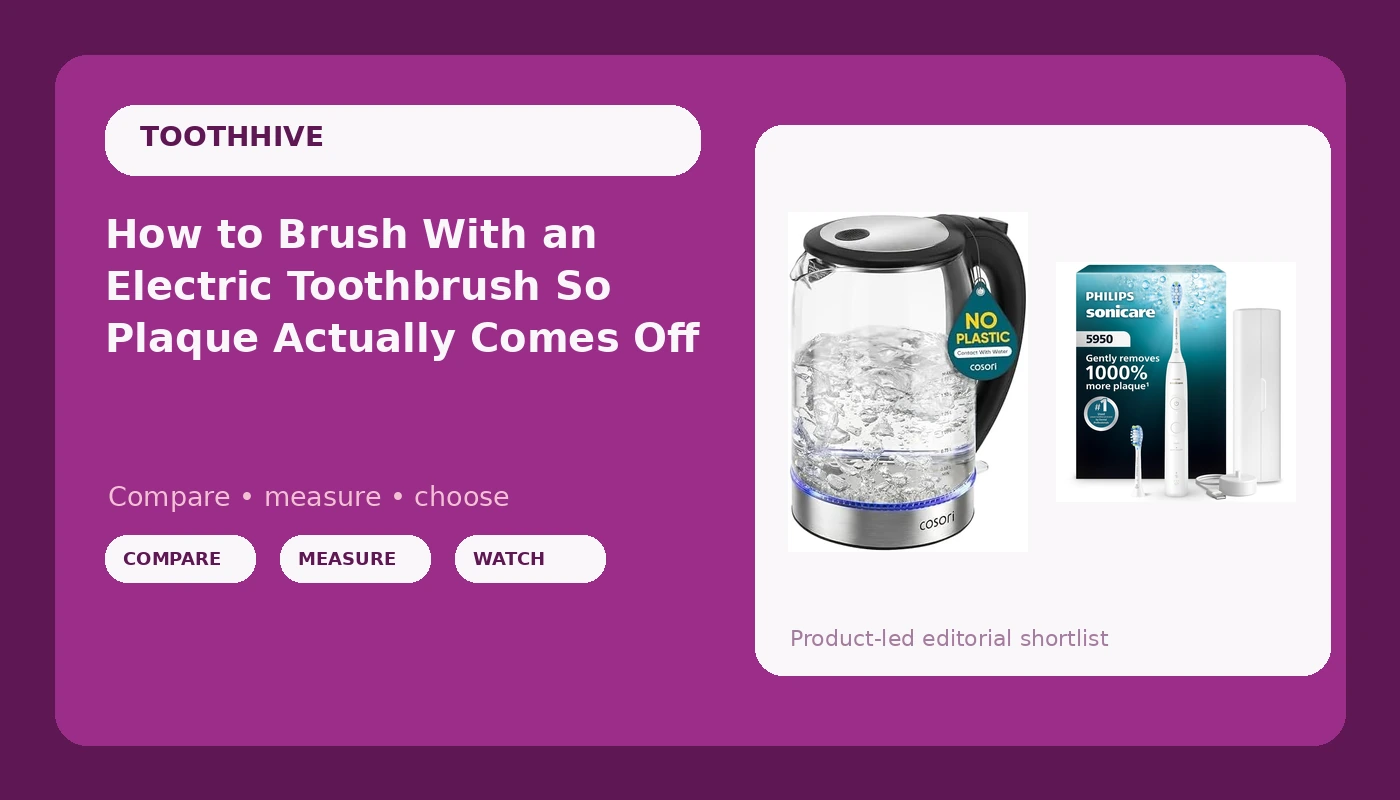
Most people who own an electric toothbrush are running a very expensive manual brush. They turn it on, drag it across their teeth for about forty-five seconds, rinse, and drop it back in the cup. The motor did its job. Nobody ever told them what an electric toothbrush routine is actually supposed to look like.
I am a dental hygienist in Madison, Wisconsin, and I have spent fourteen years looking into mouths under a disclosing tablet. The pattern is depressingly consistent. The patients with the most expensive brushes are not the patients with the cleanest teeth. The patients with the cleanest teeth are the ones who figured out the boring part: two minutes, twice a day, quadrant by quadrant, with the pressure sensor staying quiet.
So this is not a buying guide that ends with "spend more." It is the routine I walk every patient through in the chair, plus the two items I keep on my own bathroom counter to make that routine easy enough to keep.
Why you should trust me
I have worked as a dental hygienist for fourteen years, most of it in a general practice where I see the same patients every three to six months. That recall schedule is the part that matters for this article. I do not see a brush once, in a package, on a good day. I see what a brush did over a year, in a mouth that also drinks coffee and eats crackers, used by a person who is tired at 10:40 p.m. and wants to be in bed.
I use plaque-disclosing tablets on almost every adult patient, which means I am not guessing about what came off and what stayed on. I have watched people brush with an inexpensive sonic brush and leave with a clean score, and I have watched people brush with a connected flagship and leave the same plaque behind the lower molars they have been leaving behind for two years.
My bias, stated up front: technique beats technology. A brush with a quadrant timer and a real pressure sensor does the job. The app is not the feature.
How I picked and how I tested
I do not rank brushes by how they feel in the hand for ten minutes. I judge them on four things, in this order.
Does it have a two-minute timer with 30-second quadrant intervals? Is there a pressure sensor, and does it actually warn you? What do replacement heads cost over a year, and can you buy them without a subscription? And the one that matters most: do my patients still use it at the three-month recall?
That last question kills more brushes than the first three combined. A brush that lives in a drawer is a zero, no matter what it cost or how well it cleans on paper.
Everything below is either something I have watched patients use across multiple recall visits or something that sits in my own bathroom. There is also one item in this article that has nothing to do with cleaning teeth, and I will say so plainly when we get to it, because I would rather be honest than pad a list.
What the brush has to do before you buy it
Two features. I do not care much about the rest.
A quadrant timer, which is what makes two minutes happen instead of forty-five seconds. And a pressure sensor, which is what keeps you from scrubbing your gums into recession. The recession I see in the chair is rarely from skipping brushing. It is from brushing hard with a soft brush and a heavy hand for twenty years.
If a brush has neither of those, it is a manual brush with a motor, and you can buy a manual brush for a lot less money. Motor type is the third question, not the first. Sonic brushes vibrate. Oscillating brushes spin a round head. Both remove plaque when you use them correctly, and neither one rescues bad technique.
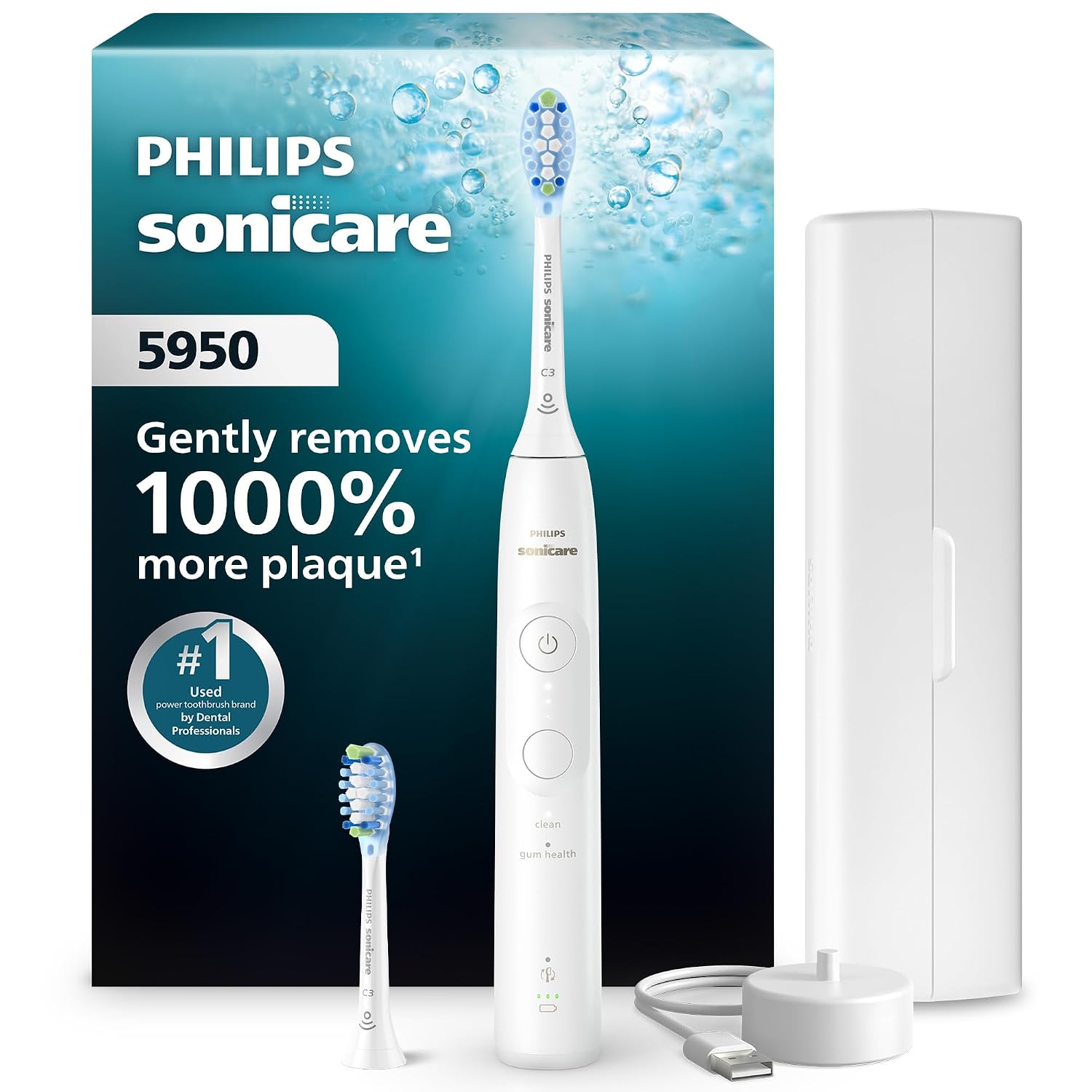
Our pick: Philips Sonicare 5950 Rechargeable Electric Toothbrush, 2 Brush Head, White
 Visit on Amazon →
This is the brush I point most patients at when they want a Sonicare without flagship money. It is a rechargeable sonic brush, and it comes with two heads in the box, which at the three-month replacement schedule below is roughly six months of brushing before you buy anything else.
The head geometry is the reason I keep sending people here. A compact head reaches the back of the lower molars where I find the most plaque on adults, and it does it without you having to unhinge your jaw to get there. When you open the listing, confirm the two things that matter to me: a quadrant timer and a pressure sensor. If those are there, you are done shopping.
Flaws but not dealbreakers: The heads are the real cost. The handle is the cheap part over five years; the replacement heads are the line item that adds up, so price a multi-pack before you commit to the handle. Sonic brushes also take a week or two to get used to if you are coming off a manual brush, mostly because the vibration feels like too much at first. It is not. Let the brush sit still on each tooth and let it work.
If you want a straightforward rechargeable brush rather than a connected one, this is where I would start.
The counter item that keeps the habit alive
The next item is not a dental device, and I am not going to pretend it is. It is a kettle. It earns a place in this article for one reason: cold water hurts, and people who find rinsing painful stop rinsing.
A good share of the sensitivity complaints I hear in a month come down to temperature. Receded gums, worn enamel, a tooth that has been crowned, and suddenly a mouthful of cold tap water at 6:45 a.m. is a punishment. Patients who cannot tolerate cold water often stop rinsing after brushing altogether, and then they wonder why their breath got worse. Warm water solves the comfort problem without changing anything about the cleaning.
If you do not have sensitivity, skip this section. You do not need a kettle to brush your teeth.
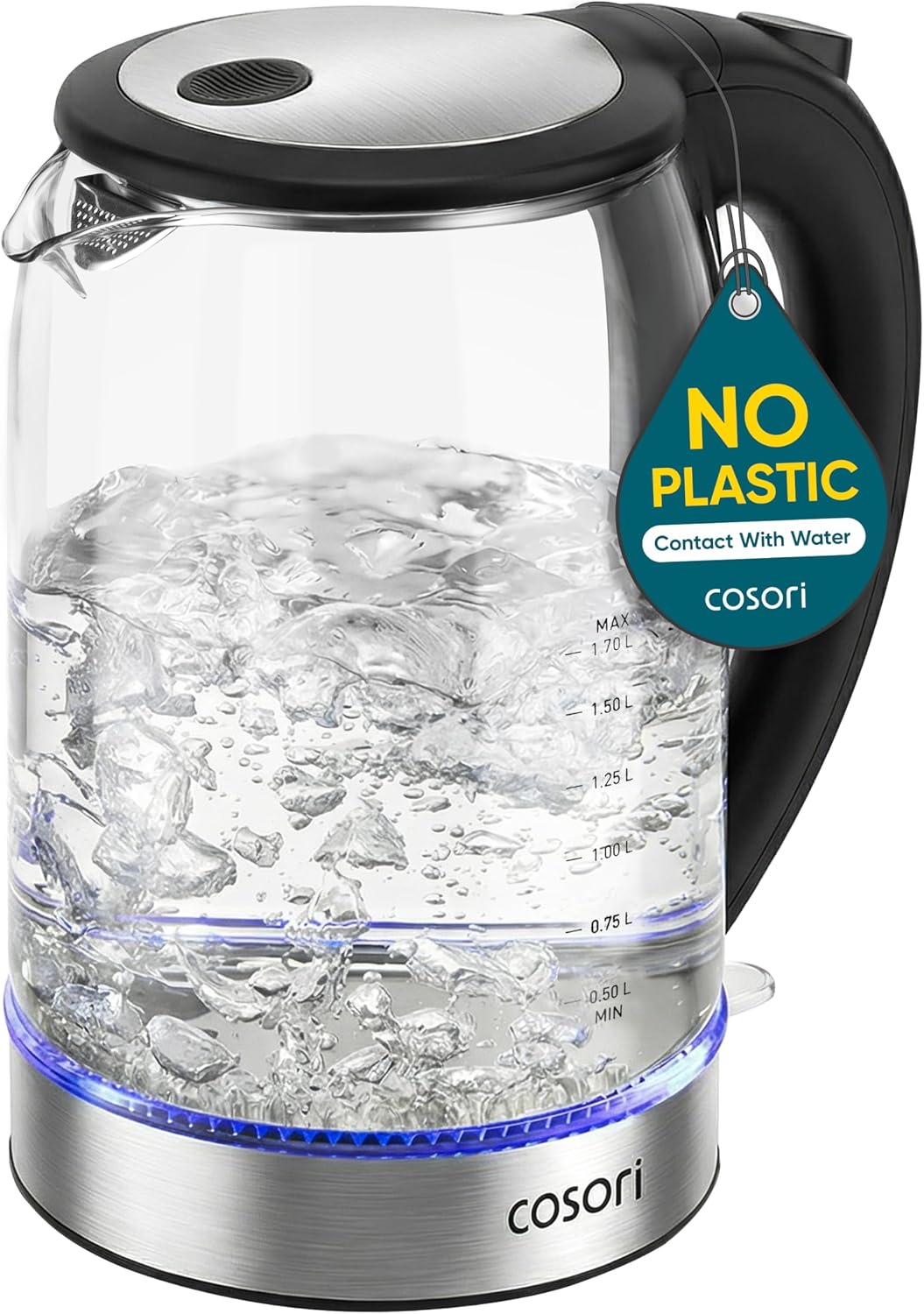
Also on the counter: Cosori Electric Kettle, No Plastic Contact with Water, 1.7L, Black
 Visit on Amazon →
The Cosori is the one on my counter. It holds 1.7 liters, which is more than one person needs for a morning rinse and a cup of tea, and it is black, which hides the hard water spots a white kettle collects in a Wisconsin winter. The feature that pushed me to this one over the cheaper kettles is right in the name: no plastic contact with water. What you pour has not been sitting against a plastic housing, which matters to me because this is water I am putting in my mouth, not just boiling for pasta.
Flaws but not dealbreakers: It is a kettle. It takes counter space, it needs descaling every couple of months if your water is hard, and it will not clean a single tooth. If your bathroom counter is already crowded, this is the first thing to cut from the list.
Anyone with sensitive teeth, receding gums, or a household that drinks warm water all day instead of soda will get more use out of it than they expect.
The actual two-minute routine
Now the part that matters more than any brush on this page. This works with any electric brush that has a quadrant timer, and it works with a manual brush if you own a kitchen timer.
Step one: Angle the head at the gumline. Forty-five degrees, so half the bristles sit on the tooth and half sit on the gum. Most people brush the crowns of their teeth and never touch the seam where the tooth meets the gum, which is exactly where plaque starts and exactly where I find bleeding.
Step two: Let the timer run the clock. Thirty seconds upper right, thirty upper left, thirty lower left, thirty lower right. Four quadrants, two minutes. The timer is the point. Without it, almost everyone brushes for forty-five seconds and calls it a night.
Step three: Move one tooth at a time. The brush does the cleaning. Your hand steers. If you are scrubbing back and forth the way you would with a manual brush, you are fighting the motor and missing the point.
Step four: No pressure. Hold the handle with your fingertips, not your fist. If your gums bleed when you brush, or the brush stalls out, you are pushing. Bleeding during brushing is not normal, and it is usually a technique problem before it is a disease problem. If it keeps up past two weeks, that is a dentist appointment, not a brush upgrade.
Step five: Spit, do not rinse. Rinsing with water after brushing washes the fluoride off your teeth. Spit out the excess and walk away. Skip the mouthwash for thirty minutes, too.
Step six: Brush before breakfast. Acid softens enamel, and brushing softened enamel wears it down. If you brush after eating, wait thirty minutes. If you cannot wait, brush first and eat after.
Step seven: Do not skip the night brush. The two minutes before bed matter more than the two minutes in the morning, because saliva production drops while you sleep and the plaque you leave behind has all night to work.
Step eight: Replace the head every three months. Splayed bristles do not reach the gumline and they hold bacteria. Write the date on the head with a marker if you have to. Most people are brushing with a head that is eight months old and wondering why the brush feels weaker than it used to.
Two minutes, twice a day, is the whole job. If you take one thing from this article, take the timer.
The competition and why it lost
There are three kinds of brushes I do not recommend, and none of them are bad machines.
The connected flagship loses on value. An app-connected brush that scores your brushing is a fine piece of engineering, and the app genuinely can nudge people who like data. But the cleaning comes from the timer and the pressure sensor, and both of those exist on brushes that cost a fraction of the flagship. You are paying for the software and the finish, not for a cleaner mouth. If the app is what gets you to two minutes, fine, that is a compliance tool and I will not argue with results. Just know what you bought.
The subscription-head brush loses on the head. The handle is inexpensive and pleasant, and the delivery is convenient, and I understand the appeal. But a small round head on a light motor is closer to a powered manual brush than to a full electric, and the head cost over a year is the thing that decides whether it is a good deal. Do that math before you sign up, not after.
The manual brush does not lose, actually. A soft manual brush with good technique beats a good electric brush with bad technique. What the electric brush buys you is the timer and the pressure sensor doing the counting for you, which is worth real money if you are the kind of person who brushes for forty-five seconds and swears it was two minutes. That is most people.
On motor type: sonic versus oscillating is the least interesting question in this article. Both work. Pick the head shape that reaches your back molars comfortably and the brush you will actually pick up twice a day.
What this all costs
The brush is a one-time purchase. The heads are the recurring one, and the recurring one is where the money goes over five years. Before you buy a handle, price a multi-pack of heads for it. If a year of heads costs as much as the handle did, that is a subscription with extra steps, and you should know that going in. Check current Amazon price on both items above before you decide anything, because prices move and my job is not to guess them.
The honest math is this: the routine is free. The brush is a modest one-time cost, the heads are a modest recurring one, and the kettle is optional comfort. What you are actually buying with any of it is compliance, meaning the odds that you will still be doing this in six months. A brush that lives in a drawer costs more per clean tooth than any flagship.
For most people, the brush is where the money should go and the kettle is a nice-to-have. If your teeth are sensitive, flip that order.
You do not need a better toothbrush. You need a timer, a pressure sensor, a head that is less than three months old, and two minutes twice a day. Your gums do not care what the app says. They care whether you showed up.
That is the whole routine. Two minutes. Twice a day. Let the brush do the work.